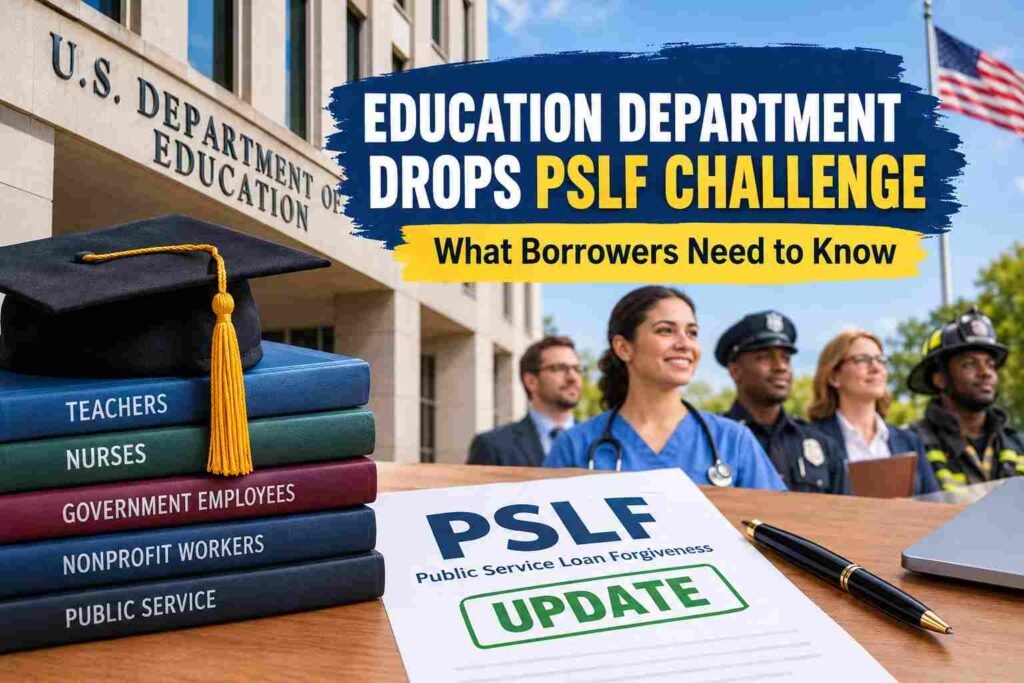
Education Department Drops PSLF Challenge: What It Means for Student?
The news that the education department drops PSLF challenge is a major turn in the ongoing debate over federal student loan forgiveness in the United States. In October 2026, the Trump administration gave up its appeals defending controversial restrictions on the Public Service Loan Forgiveness program, after federal courts struck down the proposed changes.
For millions of Americans who count on loan forgiveness while working in public service, this is an important development. Teachers, nurses, government employees, firefighters, public defenders and nonprofit workers have long seen PSLF as a possible route to wiping out their remaining eligible federal student loan debt.
The controversy began when the administration introduced a rule that would have let the Department of Education disqualify certain government agencies and nonprofit organizations from the program if their activities were found to have a “substantial illegal purpose.” Critics said the wording was far too broad and could put workers’ eligibility at risk because of what their employers did.
Federal judges then struck down the rule, and the administration’s decision to drop its appeals leaves those rulings standing. For borrowers, that brings more certainty about the rules governing the program, though it doesn’t automatically forgive every eligible worker’s loans or settle other student loan policy fights.
In this article, we explain the latest PSLF news, why the government dropped its legal challenge, what the courts decided, who could benefit and what borrowers should do next.
1. What Does Education Department Drops PSLF Challenge Mean?
The phrase education department drops pslf challenge refers to the administration’s decision to stop defending controversial restrictions on the federal Public Service Loan Forgiveness program in two appeals.
On October 21, 2026, the Justice Department withdrew its appeals of two federal court rulings that had blocked the administration’s attempt to change the program’s employer eligibility requirements. The news became public over the following days, and state attorneys general and groups representing public service workers welcomed it.
The withdrawn appeals involved a rule that would have given the education secretary more power to exclude government and nonprofit employers from PSLF if the department decided they engaged in activities with a substantial illegal purpose. The courts had already ruled against the restrictions, finding problems with both the department’s authority and the rule’s wording.
The key point for borrowers is that the controversial restrictions were struck down and the administration stopped pursuing appeals in two related cases.
That doesn’t mean the whole student loan system has changed. It also doesn’t mean everyone who works for a nonprofit automatically qualifies for forgiveness. The existing PSLF requirements on eligible employment, qualifying loans, repayment and the required number of payments still apply.
The distinction matters because headlines about student loan forgiveness can suggest that a legal win automatically cancels balances. In reality, the decision protects the program’s existing framework from the specific restrictions challenged in court.
2. Latest PSLF News in October 2026
The latest development follows months of legal fighting over the future of Public Service Loan Forgiveness.
The administration finalized its controversial PSLF rule in October 2025. The changes were meant to let the Department of Education remove certain employers from the program based on findings of substantial illegal activity.
States, nonprofit organizations, cities and advocacy groups challenged the policy. They argued that the department’s broad standard could let officials target organizations over lawful activities or political disagreements with the administration.
In June 2026, federal judges issued decisions striking down the rule. One significant ruling came from U.S. District Judge Myong Joun in Massachusetts on June 30. Another came from U.S. District Judge Amir Ali in Washington, D.C., in a separate case.
The administration then appealed the adverse decisions. On October 21, though, it withdrew two appeals instead of continuing the fight. That left the relevant rulings in place, and public service advocates welcomed the move.
Key dates in the PSLF legal dispute
| Date | Development |
|---|---|
| 2007 | Congress established the Public Service Loan Forgiveness program. |
| October 2025 | The administration finalized a rule changing employer eligibility standards. |
| June 2026 | Federal courts struck down the controversial restrictions. |
| July 1, 2026 | The rule was scheduled to take effect, but court rulings blocked it. |
| October 21, 2026 | The administration withdrew two appeals defending the rule. |
| October 22–23, 2026 | Government officials, advocacy groups and news organizations discussed the implications of the decision. |
The timeline shows that the October move wasn’t the start of the legal dispute. It was a significant step toward ending the administration’s defense of the contested restrictions.
Borrowers should also keep this dispute apart from other student loan issues, including repayment plan changes, payment-count adjustments, application backlogs and separate legal challenges affecting federal student aid.
3. What Is Public Service Loan Forgiveness?
The Public Service Loan Forgiveness program, known as PSLF, is a federal program designed to encourage people to build careers in public service.
Congress created it in 2007 to help government agencies and qualifying nonprofits attract and keep employees. Public service jobs can be rewarding, but salaries may be lower than those in some private-sector roles. Student loan forgiveness can make these careers more affordable.
Under the program’s established framework, eligible borrowers can have their remaining qualifying federal student loan balance forgiven after making 120 qualifying monthly payments while meeting the program’s employment and other requirements.
Those payments generally add up to about 10 years of qualifying repayment, though a borrower’s individual timeline can vary depending on circumstances and payment history.
Who can benefit from PSLF?
The program can matter to employees of qualifying employers in several fields.
- Teachers and education professionals: Employees of eligible public schools and qualifying educational organizations may be able to pursue PSLF while working in education.
- Healthcare workers: Nurses and other professionals employed by qualifying government hospitals or nonprofit healthcare organizations may be eligible.
- Government employees: Workers employed by eligible federal, state, local or tribal government organizations can potentially qualify.
- Firefighters and emergency personnel: Employees of qualifying public agencies may benefit from the program.
- Nonprofit employees: Workers at eligible nonprofit organizations can qualify if they meet the program’s applicable requirements.
- Public defenders and legal aid professionals: Employees of qualifying government offices or nonprofit legal organizations may be eligible.
Eligibility isn’t decided by job title alone. The employer’s status, the type of federal loans involved, the repayment history and other program requirements all play a part.
For example, two nurses doing similar work could end up with different PSLF outcomes if one works for a qualifying nonprofit hospital and the other works for a private, for-profit employer that doesn’t qualify.
That’s why borrowers should check their own employment and loan circumstances and not rely only on general descriptions of eligible careers.
4. Why Did the Trump Administration Challenge PSLF?
The controversy centered on changes that would have given the Department of Education more power to exclude certain employers from the PSLF program.
Under the administration’s rule, an employer could potentially be disqualified if officials decided it had a substantial illegal purpose. The rule listed categories of conduct the department could weigh in making such determinations.
The administration argued that the policy would keep organizations engaged in illegal activities from benefiting from a federal student loan forgiveness program.
Opponents, however, questioned how the department would interpret the rule and how much discretion it would hand to government officials.
Concerns about employer eligibility
Critics said the language was too broad and could create uncertainty for employees who had spent years working toward PSLF.
Among the activities raised in the controversy were services or initiatives involving immigration, gender-affirming care for minors, diversity, equity and inclusion programs, and other activities that could become the subject of legality disputes.
Opponents argued that a broad reading could put employees at risk of losing access to a program because of their employer’s activities, even when the employees themselves had done nothing wrong.
Workers who could have been affected included employees of schools, hospitals, legal aid organizations and other public service institutions.
So the dispute wasn’t only about whether illegal activity should have consequences. It was also about the government’s authority to decide employer eligibility, the legal standards behind those decisions and whether the rule could reach lawful conduct protected by the Constitution.
Why the issue mattered to borrowers
Picture an employee who has spent nine years at a qualifying nonprofit and has made years of qualifying student loan payments.
If the employer were dropped from PSLF eligibility under a new rule, that employee could face doubt about whether future work would count toward forgiveness.
Depending on the circumstances and applicable rules, that uncertainty could affect career decisions, financial planning and the employee’s willingness to stay in a public service job.
This potential disruption was one reason the restrictions drew opposition from state governments, nonprofit organizations and groups representing student borrowers.
The litigation ultimately turned on whether the department could lawfully impose the restrictions, and not simply on whether the administration thought they were good policy.
5. Why Did Federal Courts Reject the PSLF Rule?
Federal judges rejected the challenged restrictions after considering whether the Department of Education had the legal authority to adopt them and whether the rule met applicable legal standards.
The June 2026 rulings mattered because they kept the restrictions from taking effect as planned.
One central worry was the breadth of the phrase “substantial illegal purpose.” Opponents argued that the wording could give officials too much discretion to decide which employers stayed eligible for PSLF.
The courts found legal problems with the department’s approach, including concerns about statutory authority and constitutional protections.
In the Massachusetts case, Judge Myong Joun’s June 30 decision vacated the rule. A separate decision by Judge Amir Ali also blocked the challenged restrictions in litigation brought by nonprofit organizations.
The question of government authority
Federal agencies must act within the authority Congress gives them.
Agencies can write regulations to run federal programs, but those rules have to comply with the governing statutes and other legal requirements.
The challengers argued that Congress created PSLF to support eligible public service workers and didn’t authorize the department to impose the disputed employer exclusions in the way it proposed.
The courts’ rulings rejected the challenged rule, leaving the department without the restrictions it had tried to introduce.
First Amendment concerns
Another key issue involved the First Amendment, which protects free speech and other constitutional rights.
Opponents argued that the rule could penalize organizations over lawful activities, advocacy or positions that government officials disliked.
The courts flagged constitutional concerns alongside issues about the department’s statutory authority and the rule’s wording.
Those concerns mattered because federal programs should run on lawful eligibility standards and not on rules that improperly discriminate against organizations or penalize constitutionally protected conduct.
Why dropping the appeals matters
When the administration withdrew its appeals, it stopped challenging those particular adverse court decisions.
That’s significant because the government had earlier asked for appellate review after losing in court.
With the appeals withdrawn, the relevant decisions stayed in place. That removed a major source of uncertainty around the proposed PSLF restrictions.
Borrowers shouldn’t read this as a ruling that every possible PSLF policy dispute is over, though. Other questions involving student loans, repayment arrangements, administrative processing and eligibility can still come up on their own.
6. Who Benefits From the Latest PSLF Decision?
The latest development matters most for borrowers whose employers could have faced uncertainty under the rejected rule.
It gives more reassurance that the controversial restrictions won’t be put in place through the appeals that were withdrawn.
Several groups may find the outcome especially relevant.
Public school teachers
Teachers who work for qualifying public school employers often pursue PSLF as part of their long-term financial planning.
Student loan debt can shape where educators choose to work, especially when public-sector pay doesn’t match what’s available in some private-sector careers.
The decision helps protect the existing PSLF framework from the specific employer restrictions challenged in court.
Teachers must still meet the program’s ordinary requirements, though. Working in education alone doesn’t guarantee forgiveness.
Nurses and healthcare workers
Healthcare professionals can carry large student loan balances after university, nursing school or other professional training.
Those working for qualifying government or nonprofit healthcare employers may be eligible for PSLF.
The decision reassures workers who worried their employers could have been excluded under the challenged restrictions.
It doesn’t establish universal eligibility for every hospital or healthcare professional. Borrowers should check their employer’s status and their own qualifying payments.
Nonprofit employees
Nonprofit organizations were at the heart of the legal controversy because the disputed rule could have let officials remove certain employers from the program.
Employees of qualifying charitable, educational, healthcare and community-service organizations may therefore have a particular stake in the outcome.
Withdrawing the appeals reduces uncertainty tied to the challenged restrictions and supports keeping the existing eligibility framework.
Government workers
Federal, state, local and tribal government employees can potentially qualify for PSLF when they meet the program’s requirements.
Government employees in areas such as law enforcement, public administration, emergency response and public education may find the decision relevant to their long-term loan repayment plans.
Even so, borrowers must confirm that their employment and loan history satisfy the applicable rules.
Public defenders and legal aid workers
Public defenders and employees of qualifying legal aid organizations may count on PSLF because their work supports access to legal services and not top private-sector earnings.
The legal fight drew in organizations worried that the proposed rule could put workers at risk over activities carried out by their employers.
The administration’s withdrawal of the appeals gives employees concerned about those specific restrictions more certainty.
Overall, the decision benefits the wider public service workforce by reducing uncertainty about a proposed change that could have affected employer eligibility and the workers those employers hire.
7. Does the Decision Change PSLF Eligibility Rules?
The short answer is that the decision protects the existing framework from the specific restrictions challenged in court; it doesn’t create a new, automatic path to forgiveness.
Borrowers should keep evaluating their eligibility under the established PSLF requirements.
Those requirements generally cover four main areas.
First, qualifying employment. Borrowers must work for an eligible government employer or qualifying nonprofit organization. Employer eligibility is separate from a person’s job title.
Second, qualifying federal loans. Not every education loan automatically qualifies. Borrowers should check whether their loans meet the program’s requirements and whether any needed loan consolidation would affect their situation.
Third, qualifying payments. PSLF generally requires 120 qualifying monthly payments. Not every payment made toward a student loan necessarily counts toward that total.
Fourth, applicable repayment and certification requirements. Borrowers must meet the rules on qualifying repayment and document their eligible employment and payment history.
The administration’s withdrawal of its appeals doesn’t remove any of these conditions.
What if you already have qualifying payments?
If you’ve been working for a qualifying employer and making qualifying payments, review your current payment count and employment records.
The legal decision doesn’t automatically raise your count to 120 payments.
It also doesn’t guarantee that every past payment will qualify. Payment-count adjustments and individual account reviews are separate matters.
What if your employer is a nonprofit?
Don’t assume every nonprofit qualifies or that every employee of an eligible organization automatically gets forgiveness.
Check your employer’s eligibility through the official federal student aid process and keep documentation of your employment.
The key point is that the controversial restrictions challenged in court are different from the ordinary PSLF eligibility requirements.
What if you are close to forgiveness?
Borrowers nearing 120 qualifying payments should pay special attention to their account records.
Review your qualifying payment count, verify your employment history and follow the current instructions for submitting a forgiveness application.
Because individual loan circumstances vary, borrowers should consult official guidance before making major decisions about repayment, consolidation or employment.
8. How to Qualify for Public Service Loan Forgiveness
For borrowers hoping to benefit from PSLF, the most practical next step is to confirm their eligibility and organize their records.
The following process is a useful starting point.
Step 1: Review your federal student loans
Identify the types of federal student loans you hold and check whether they qualify for PSLF.
If you have several loans, review each one separately. Don’t assume the status of one loan automatically decides the status of every loan on your account.
Private student loans generally don’t qualify for the federal PSLF program.
Step 2: Confirm your employer’s eligibility
Check your employer’s status through the official federal student aid website.
Government employment and employment at qualifying nonprofit organizations can meet the program’s requirements, but eligibility depends on the applicable rules.
Keep records that identify your employer and document the period you worked there.
Step 3: Submit employment certification
Use the official PSLF process to document qualifying employment.
Submitting employment information helps show whether your work meets the program’s requirements and can help spot problems before you reach the end of your repayment period.
Follow the current instructions for completing and submitting the required forms.
Step 4: Review your qualifying payment count
Check your federal student loan account for information about payments credited toward PSLF.
If the payment count doesn’t match your records, look into the discrepancy through the appropriate official channels.
Keep copies of relevant statements and correspondence.
Step 5: Understand your repayment arrangement
Confirm that your repayment arrangement meets the applicable PSLF rules.
Student loan policies and repayment options can change, so rely on current official guidance and not outdated online advice.
Before switching repayment plans or consolidating loans, understand how the decision could affect your account and qualifying payment history.
Step 6: Apply when eligible
Once you believe you’ve completed the required qualifying payments and employment period, follow the official process for applying for forgiveness.
Make sure your employment documentation and loan records are accurate.
If the department asks for more information, respond according to the instructions you’re given.
Step 7: Keep copies of important documents
Keep a record of employment certifications, loan statements, payment histories, application submissions and official responses.
These documents can help if you need to correct an error or explain a discrepancy.
Official resource: Borrowers can review the program’s current requirements through the U.S. Department of Education’s Federal Student Aid website at Federal Student Aid.
9. What Borrowers Should Do After the Decision
The latest PSLF development is encouraging for eligible public service workers, but borrowers shouldn’t make major financial decisions based on a headline alone.
Instead, focus on steps that protect your eligibility and clarify where you stand.
Check your PSLF payment history
Review your account and work out how many qualifying payments have been credited.
If your records show fewer payments than you expected, gather the relevant documentation before contacting the appropriate loan servicer or federal student aid office.
Verify your employer
Make sure your employer meets the current PSLF requirements.
If you work for a nonprofit, confirm its eligibility and don’t assume tax-exempt status settles every question.
Avoid unnecessary repayment changes
Don’t switch repayment arrangements or consolidate loans without understanding the possible consequences.
Some decisions may affect how your loans or payment history are treated. Review the current official guidance and consider seeking qualified advice if your situation is complicated.
Watch for official announcements
Withdrawing the appeals settles an important part of the dispute, but other student loan policies and administrative procedures can change.
Check official Federal Student Aid communications for updates on applications, payment counts, repayment options and eligibility.
Be cautious about forgiveness scams
News about student loan forgiveness often attracts misleading ads and fraudulent services.
Be wary of anyone who promises guaranteed forgiveness for an upfront fee or asks you to share sensitive account information through an unverified channel.
Use official federal websites and verified loan servicing contacts when reviewing your options.
These steps can help borrowers respond constructively to the latest news without assuming the legal development has automatically changed their individual accounts.
10. Does the Decision Affect Student Loan Forgiveness Processing?
Withdrawing the PSLF appeals concerns the legality of a proposed employer eligibility rule. It doesn’t, on its own, resolve every administrative problem affecting student loan borrowers. Some borrowers may still have questions about payment counts, application processing times, account adjustments or the status of their forgiveness requests.
These issues should be kept separate from the litigation over the controversial restrictions. For example, a borrower could be shielded from the challenged employer rule but still need to fix an error in their payment history. Another borrower might work for a qualifying nonprofit but still need to confirm that their loans and repayment history meet the program’s requirements.
A third borrower might have hit the required payment count but still need to complete the application process. The October decision doesn’t automatically settle those individual circumstances.
Why accurate account records matter
PSLF depends on whether a borrower meets the relevant requirements over time.
Employment records, loan information and qualifying payment counts can therefore be essential in deciding eligibility.
Borrowers who think their accounts contain errors should keep documentation and use official channels to ask for clarification.
They should also avoid relying on generalized claims about the number of payments required or the status of a particular repayment plan without checking current federal guidance.
What about borrowers whose employers were concerned?
Employees of qualifying organizations touched by the controversy may find the withdrawal of the appeals reassuring.
But the decision shouldn’t be read as an automatic certification of every employer or a guarantee that every employee will receive forgiveness.
Individual applications are still subject to the applicable rules.
The practical benefit is more certainty that the specific restrictions struck down by the courts won’t be carried out through the withdrawn appeals.
11. PSLF vs. Other Student Loan Forgiveness Programs
Public Service Loan Forgiveness is just one piece of the federal student loan system.
Borrowers should understand how PSLF differs from other forms of student loan relief, since eligibility requirements and consequences can vary.
| Program or relief option | Main purpose | Important consideration |
|---|---|---|
| Public Service Loan Forgiveness | Forgives remaining eligible federal student loan debt after qualifying public service and payments | Employer eligibility and qualifying payment history matter. |
| Teacher-specific loan forgiveness | Provides eligible teachers with forgiveness under a separate program | Requirements differ from PSLF, and borrowers should review how programs interact. |
| Income-driven repayment forgiveness | May forgive remaining eligible balances after a qualifying repayment period under applicable plan rules | Availability and requirements depend on current federal policy and the borrower’s circumstances. |
| Military-related student loan benefits | Certain programs provide repayment assistance or other benefits to eligible service members | Benefits vary by program and service requirements. |
| State or employer assistance | Some states and employers provide loan repayment assistance | Eligibility, funding and service obligations vary. |
The October 2026 PSLF decision deals specifically with the challenged restrictions on employer eligibility. It doesn’t set new eligibility rules for any other forgiveness program.
Borrowers should compare their options carefully before deciding on repayment or employment.
For some people, PSLF may be the best route. Others may qualify for a different program or a mix of benefits allowed under the relevant rules.
The right choice depends on loan type, employer, payment history, career plans and current program requirements.
12. What Happens Next for PSLF?
The administration’s decision to abandon the two appeals is a significant development, but it shouldn’t be treated as the end of every dispute over federal student loans.
The immediate result is that the relevant court rulings stay in place, blocking the restrictions challenged in those cases.
The broader PSLF program keeps operating under its existing legal framework, subject to applicable eligibility rules and any other lawful changes.
Will the government introduce another PSLF rule?
Future policy changes are possible, but borrowers shouldn’t assume a new restriction is inevitable.
Any new rule would have to comply with applicable laws and could face legal challenges if affected parties believed it exceeded the department’s authority or violated other legal protections.
For now, borrowers should focus on the rules currently in force and not speculate about hypothetical changes.
Could the decision affect public service recruitment?
PSLF was created partly to encourage graduates to take jobs in government and qualifying nonprofit organizations.
When employees trust that a program will run under stable eligibility rules, they may find it easier to plan their careers and finances.
Withdrawing the appeals could therefore help reduce uncertainty for workers deciding whether to stay in qualifying public service jobs.
The actual effect on recruitment and retention, though, will depend on many factors, including salaries, student debt levels, working conditions and how the program is administered.
Will borrowers receive forgiveness automatically?
No. Withdrawing the appeals doesn’t automatically forgive borrowers’ balances.
Eligible borrowers still need to meet the applicable requirements and follow the relevant procedures.
Anyone who thinks they qualify should review their records, confirm their payment count and follow the official application instructions.
What should borrowers watch for?
The most useful updates will involve official PSLF guidance, application processing, payment-count accuracy, repayment arrangements and any further legal developments.
Borrowers should also watch for official communications about their own accounts.
These sources are more reliable for individual decisions than social media posts or headlines that may oversimplify the legal outcome.
13. Frequently Asked Questions
1. Why did the Education Department drop the PSLF challenge?
In October 2026, the administration withdrew appeals defending a rule that would have let certain government and nonprofit employers be excluded from PSLF based on a finding that they had a substantial illegal purpose. The appeals came after federal court decisions struck down the challenged restrictions. The initial reporting gave no detailed public explanation from the administration for withdrawing the appeals.
2. Does the PSLF decision mean student loans will be forgiven automatically?
No. The decision doesn’t automatically cancel borrowers’ student loan balances. Borrowers must still meet the applicable PSLF requirements, including qualifying employment, eligible loans and 120 qualifying monthly payments. Those who believe they qualify should verify their account information and follow the official forgiveness application process.
3. Who qualifies for Public Service Loan Forgiveness?
PSLF may be available to borrowers with eligible federal student loans who work for qualifying government employers or nonprofit organizations and meet the program’s repayment and payment-count requirements. Teachers, nurses, public defenders, government workers and other public service employees may qualify, depending on their specific circumstances.
4. Does the decision help teachers and nurses?
It can reassure teachers, nurses and other public service employees whose qualifying employers could have faced uncertainty under the challenged restrictions. Eligibility still depends on the employer, loans, repayment history and other applicable requirements, though. The decision doesn’t guarantee forgiveness for every teacher or nurse.
5. What should borrowers do after the government drops the appeal?
Borrowers should review their federal student loans, confirm their employer’s eligibility, check their qualifying payment count and keep accurate employment records. They should also follow official Federal Student Aid guidance for applications and repayment decisions. The legal development is important, but borrowers shouldn’t assume their individual account status has changed automatically.
6. Does the decision eliminate the 120-payment requirement?
No. Withdrawing the appeals concerns the challenged employer restrictions. It doesn’t remove the established requirement of 120 qualifying monthly payments for PSLF. Borrowers must keep meeting the applicable program rules.
7. Can nonprofit employees still qualify for PSLF?
Yes. Employees of qualifying nonprofit organizations can still potentially qualify under the existing program framework. Not every nonprofit employer or employee automatically qualifies, however. Borrowers should verify their employer’s status and their own loan and payment eligibility.
8. Where can I check my PSLF eligibility?
The official Federal Student Aid website offers information about PSLF eligibility, qualifying employment, application procedures and federal student loans. Borrowers should use the official website and verified loan servicing contacts to review their circumstances and steer clear of fraudulent forgiveness offers.
14. Final Thoughts
The news that the education department drops PSLF challenge marks an important moment in the debate over federal student loan forgiveness. By withdrawing two appeals after federal judges struck down controversial restrictions, the administration left the relevant court decisions in place and cut uncertainty around the proposed employer eligibility changes.
For teachers, nurses, government employees, public defenders and workers at qualifying nonprofit organizations, the development offers reassurance that the challenged restrictions won’t be put in place through those withdrawn appeals. It also underscores the need for clear legal standards in a program built to support people who dedicate their careers to public service.
Still, borrowers should understand what the decision does and doesn’t do. It doesn’t automatically forgive outstanding student debt, remove the 120-payment requirement or fix every problem with repayment plans and loan servicing. Individual eligibility still depends on the applicable program rules and a borrower’s circumstances.
The most practical next step is to review your federal student loan account, confirm your employer’s eligibility, check your qualifying payment history and follow official guidance when applying for forgiveness. As student loan policy keeps evolving, accurate information and careful recordkeeping will stay essential for anyone pursuing Public Service Loan Forgiveness.
Bottom line: The administration’s decision to drop the appeals is a significant development for PSLF, but borrowers should keep verifying their eligibility and watching official updates and not assume forgiveness is automatic.