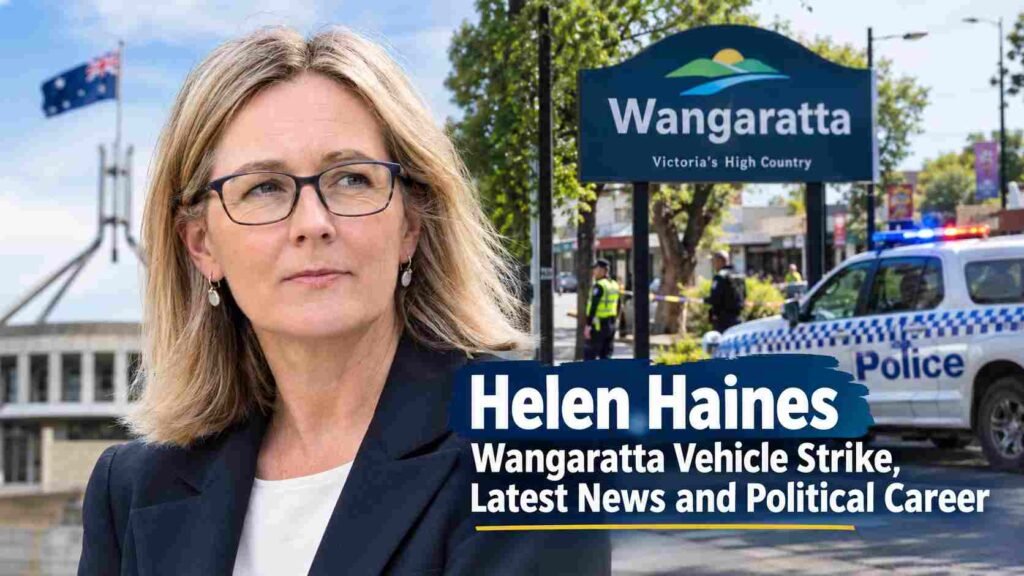
Helen Haines: Latest News on the Wangaratta Vehicle Strike
Helen Haines is an Australian independent federal politician who represents the electorate of Indi in the House of Representatives. With a background in nursing, midwifery, medical research and regional healthcare leadership, she has built a public profile around political integrity, stronger regional services and the concerns of communities in north-eastern Victoria.
On October 19, 2026, however, Helen Haines became the center of major national news after reports that she had been hit by a vehicle outside her electorate office in Wangaratta, Victoria. According to reports published that day, the incident was being investigated as a deliberate attack, and Haines was in critical condition in hospital. A suspect was taken into custody, and authorities began looking into the circumstances and a possible motive. The initial reporting did not establish a motive. Reuters and ABC News covered the incident.
The news has focused attention on the safety of Australian public officials and on the work of a politician whose career has been closely tied to regional representation and accountability in government.
For readers searching for Helen Haines, Helen Haines MP, Helen Haines Wangaratta vehicle strike or Wangaratta news, it helps to read about the reported incident alongside her professional background and parliamentary career. This article explains what was known from the early reports, what remained unconfirmed and why Helen Haines is an important figure in Australian federal politics.
News update: October 19, 2026. Details of the incident and the investigation may change as authorities release more information.
What Happened in the Helen Haines Wangaratta Vehicle Strike?
The reported Helen Haines Wangaratta vehicle strike took place outside her electorate office on Murphy Street in Wangaratta, a regional city in north-eastern Victoria.
According to reporting published on October 19, emergency services were called shortly before 4 p.m. local time. Reuters reported that Haines was hit by a white Toyota Land Cruiser and that a 43-year-old man was arrested. The prime minister called the incident a deliberate act, and authorities opened a wider investigation into what happened.
The incident was especially disturbing because it involved a sitting federal parliamentarian at a place tied to her everyday constituency work. Electorate offices are key points of contact between representatives and the people they serve, where residents can raise concerns about government services, local infrastructure, healthcare and other community issues.
The seriousness of the reported incident prompted a national response. Police and federal authorities joined the effort to examine the circumstances, and a joint counter-terrorism investigation was announced.
Where Did the Incident Occur?
The reported incident happened on Murphy Street in Wangaratta, where Helen Haines has her electorate office.
Wangaratta sits in Victoria’s north-east, roughly three hours by road from Melbourne in typical driving conditions. It is an important regional hub for surrounding towns, farming communities and rural industries.
The location matters because Wangaratta is part of the federal electorate of Indi, which Haines has represented since 2019. Her work in the region has meant direct contact with constituents and advocacy for public services that can be harder to reach in rural and regional areas.
That the incident happened outside her office made the story especially worrying for the local community and for Australians following the news.
What Is Known About Her Condition?
Early reports on October 19 said Helen Haines was in critical condition after the vehicle strike. They indicated she was taken to hospital for treatment.
At the time of those initial reports, there was no verified basis for saying she had recovered, been discharged or reached any particular medical milestone. Her family asked for privacy while she received care.
Medical updates should be handled carefully, because a person’s condition can change and early news reports don’t always reflect later developments.
Readers wanting the most recent information should consult ABC News and Reuters, along with official statements from the relevant authorities.
Has a Suspect Been Arrested?
Yes. According to initial reporting by Reuters, police arrested a 43-year-old man in connection with the incident.
Reports also said a knife was found inside the vehicle. That detail became part of the developing investigation, but it shouldn’t be taken as proof of any particular motive or as confirmation of every allegation around the case.
An arrest is an important step in an investigation, but it is not a conviction. Claims about criminal responsibility, intent or the reasons behind the incident have to be tested through verified evidence and the legal process.
Authorities hadn’t confirmed a definitive motive in the early reports. As the investigation continued, more details could emerge through official announcements and court proceedings.
Is the Incident Being Investigated as a Terrorism Case?
Initial reports said a joint counter-terrorism team had been activated to investigate the attack. The investigation involved federal and state authorities, including the Australian Federal Police, Victoria Police and the Australian Security Intelligence Organisation.
The involvement of counter-terrorism investigators doesn’t automatically mean an incident meets the legal definition of terrorism. Investigators may look at several possible explanations before reaching conclusions.
As of the initial reporting on October 19, authorities hadn’t publicly established a definitive motive. It would therefore be premature to call the incident politically motivated or ideologically driven without more evidence.
This distinction matters when covering a serious event involving a public figure. Accurate reporting should keep confirmed facts, official assessments and unanswered questions separate.
Who Is Helen Haines MP?
Dr Helen Haines is an independent member of Australia’s House of Representatives and the federal representative for Indi, Victoria.
According to the Australian Parliament’s official biography, she entered federal parliament in 2019 and was re-elected in 2022 and 2025.
Unlike representatives who belong to a major party, Haines sits as an independent. That means she isn’t formally bound to vote along a party line, though her decisions can still involve negotiation, consultation and cooperation with other members.
Her public work has centered on issues that affect regional communities, including access to healthcare, government transparency, infrastructure and services outside Australia’s biggest cities.
Her professional background also sets her apart from many politicians who spent most of their careers in party politics. Before entering parliament, she worked in nursing, midwifery, health research and regional health administration.
Helen Haines and the Electorate of Indi
Indi is a large federal electorate in north-eastern Victoria. It takes in Wangaratta, Wodonga, Benalla and a range of smaller towns and rural communities.
The electorate covers varied local economies, including agriculture, tourism, forestry, manufacturing and regional services. Residents face different challenges depending on where they live, especially around transport, medical care, jobs and reliable telecommunications.
As the Member for Indi, Helen Haines has represented this wide regional constituency since 2019.
Her role includes taking part in parliamentary debates, scrutinizing proposed legislation, speaking for local concerns in Canberra and helping constituents find their way through federal government services.
Her experience in regional healthcare has also shaped her approach to public policy, particularly how national decisions affect people who live far from major hospitals and government centers.
Why Is Helen Haines an Independent Politician?
Helen Haines entered parliament through a community-backed independent movement linked to Voices for Indi.
The movement wanted a representative who would focus on local priorities and not mainly follow the direction of a major party. Haines succeeded Cathy McGowan, who had also represented Indi as an independent.
Independent MPs can play a distinctive part in Australia’s parliamentary system. Depending on the balance of seats, their votes can influence the passage of legislation, committee inquiries and parliamentary scrutiny.
Haines has described her independence as a way to judge legislation on its merits and speak for the people of Indi.
Her work on integrity and accountability in government has been central to that approach. She has pushed for more transparency in public decision-making and stronger ways of investigating misconduct.
Helen Haines’ Early Life, Education, and Healthcare Career
Before becoming a federal MP, Helen Haines built a career in nursing, midwifery, research and healthcare leadership.
Her professional experience gave her firsthand insight into the practical challenges facing patients, healthcare workers, hospitals and rural communities. That background has informed her political priorities and helped build her reputation as a representative with experience beyond traditional party politics.
Education and Academic Qualifications
The Australian Parliament’s biography lists Haines’ qualifications as including a Bachelor of Nursing from Deakin University, a Master of Public Health from the University of New South Wales and a PhD in medical science from Uppsala University in Sweden.
She also did research and academic work connected with Swedish institutions, including the Karolinska Institutet.
These qualifications reflect a career that joined clinical practice with public health and research. Her experience bears on policy discussions about healthcare delivery, health systems, research and the gap between metropolitan and regional medical services.
Nursing and Midwifery Experience
Haines worked as a nurse and midwife before entering federal politics. Her career included roles in regional hospitals and health services.
She also served as matron and director of nursing at Chiltern Bush Nursing Hospital, where regional healthcare needs were at the heart of the work.
Nursing and midwifery mean direct contact with patients and families at important moments in their lives. That kind of experience can give insight into staffing, access to specialist treatment, continuity of care and the pressures on smaller medical facilities.
Haines has drawn on this background in her advocacy for better regional healthcare and fairer access to services.
Research and Health Leadership
Alongside her clinical work, Haines held research and leadership roles in the health sector.
Her career included work as a senior research fellow at the University of Melbourne’s Department of Rural Health and as an executive director responsible for education and research at Northeast Health Wangaratta.
She also held roles linked to regional health organizations and advisory bodies.
This history gave her experience with both individual healthcare needs and wider organizational questions. Those perspectives matter in a large regional electorate, where health services may need to reach scattered populations across long distances.
Helen Haines’ Political Career Since 2019
Helen Haines won the federal seat of Indi in 2019 after Cathy McGowan retired.
She went on to win re-election in 2022 and 2025, according to the Australian Parliament’s official member profile.
Her career has included work on regional development, infrastructure, integrity measures and public administration. As an independent, she has been able to work with members from different parties while keeping a separate parliamentary identity.
A Focus on Political Integrity
One of the most prominent themes in Haines’ parliamentary work has been integrity in government.
She has backed stronger accountability mechanisms and efforts to improve scrutiny of political and public-sector conduct.
Haines was an advocate for creating Australia’s National Anti-Corruption Commission, a federal body set up to investigate serious or systemic corruption in the Commonwealth public sector within its jurisdiction.
Her parliamentary work has included serving as deputy chair of the Parliamentary Joint Committee on the National Anti-Corruption Commission.
For supporters of political transparency, this work is an important part of her contribution to federal politics. It reflects a broader argument that democratic institutions need effective oversight, clear rules and public confidence.
Regional Infrastructure and Telecommunications
Another key issue in Haines’ work has been infrastructure for regional Australia.
Communities outside major cities depend on transport links, reliable telecommunications, public facilities and investment that supports local economies.
Poor mobile coverage causes problems for residents, emergency services, farmers, businesses and travelers in remote areas. Reliable internet is also increasingly important for education, work, telehealth and government services.
Haines has pushed for better regional telecommunications and infrastructure investment, including improvements that support communities across Indi.
These issues matter especially in Wangaratta and surrounding towns, where residents may rely on regional service centers for healthcare, education, shopping and employment.
Healthcare Access for Regional Communities
Regional healthcare has stayed a major theme in Haines’ public work.
People outside metropolitan areas can face long travel times for specialist appointments, limited availability of certain services and difficulty recruiting health professionals.
The effects reach beyond patients to families, employers, hospitals and local economies.
Haines’ experience in nursing and health administration gives her a professional footing to discuss these challenges. Her advocacy has included attention to the gap between regional and metropolitan health outcomes and the need for national action.
Her background helps explain why healthcare policy is still central to her public identity as the Member for Indi.
Climate, Energy, and Regional Economic Development
Haines has also taken part in debates about climate policy, energy investment and regional economic development.
These issues can be especially significant in north-eastern Victoria, where agriculture, tourism, forestry, manufacturing and other industries support local jobs.
The shift to cleaner energy can bring opportunities for new investment, but it can also raise questions about land use, electricity infrastructure, costs and how the economic benefits are shared among communities.
For regional representatives, the challenge is to weigh national environmental and energy goals against the practical needs of residents and businesses.
Haines’ broader political approach has stressed regional interests and accountability in government decision-making.
Why the Helen Haines Wangaratta Incident Has Attracted National Attention
The reported vehicle strike has drawn attention well beyond Wangaratta because it involves a sitting member of Australia’s federal parliament.
Politicians regularly meet constituents in public places, attend community events, visit local businesses and travel between regional towns. These activities are essential to representative democracy because they let elected officials hear directly from the people they represent.
An attack on a parliamentarian can therefore raise wider questions about public safety, political participation and the ability of elected representatives to do their jobs without fear of violence.
Political Violence and Democratic Participation
Australia has a parliamentary tradition in which elected representatives are expected to engage directly with their communities. Local offices, public meetings and community visits help sustain that relationship.
When a serious incident happens at an electorate office, it can affect not only the person involved but also staff, witnesses, constituents and the wider community.
The Helen Haines incident has renewed attention on how public officials can stay accessible while responding properly to security risks.
Security arrangements have to balance two important goals: protecting representatives and preserving the public’s ability to reach them. Too many barriers can make it harder for constituents to get help, while too few safeguards can expose politicians and their staff to needless danger.
The investigation into the Wangaratta incident may also feed into wider discussions about security practices for Australian parliamentarians.
Concerns About Threats Against Politicians
Reports around the incident have highlighted concerns about threats and harassment aimed at public officials.
According to Reuters’ October 19 reporting, Australian authorities pointed to a rise in reported threatening or harassing behavior toward senior officeholders. The exact circumstances of the Haines incident, though, have to be established by the investigation and not inferred from broader political trends.
Online abuse, personal threats and confrontational public encounters can add pressure for politicians and their staff. Social media can inflame disagreements by letting hostile comments spread quickly and sometimes anonymously.
Still, criticism of political decisions is a legitimate part of democratic debate. The important line is between expressing disagreement and engaging in intimidation, threats or physical violence.
The reported attack has prompted renewed calls for respectful political discussion and proper protection for public officials.
The Importance of Responsible Reporting
Major breaking stories often develop fast. Early accounts can contain incomplete details, and information released later may clarify or correct initial reports.
In the Helen Haines case, several important questions were unresolved in the initial reporting, particularly the motive and the full circumstances of the incident.
Responsible coverage should avoid presenting speculation as fact. It should also respect the privacy of Haines and her family while she receives medical treatment.
Readers should be wary of unverified social media posts, fabricated quotations, misleading photographs and claims that name a motive before investigators have established one.
For anyone following Helen Haines latest news, official announcements and established news organizations are the best places to look for confirmed developments.
Wangaratta, Victoria: The Community at the Centre of the News
Wangaratta is a regional city in north-eastern Victoria and an important service hub for the surrounding area.
The city supports residents from nearby towns and rural districts who depend on its healthcare facilities, education providers, businesses, shops and transport connections.
Its location makes it a key part of the wider regional economy, with links to agriculture, tourism, manufacturing and other industries.
Why Wangaratta Matters to the Electorate of Indi
Wangaratta is one of the main population centers in the federal electorate of Indi. The electorate also includes Wodonga, Benalla, Beechworth, Mansfield and many smaller communities.
These places have different economic circumstances and service needs. Some lean heavily on agriculture and regional industries, while others benefit from tourism, education, healthcare and access to outdoor recreation.
A representative for Indi therefore has to consider a wide range of issues, including transport, mobile coverage, employment, housing, health services and local economic development.
Helen Haines’ professional background and parliamentary work have often centered on these regional concerns.
The Impact of Breaking News on a Regional Community
A serious incident in a regional city can have a big local impact, especially when it involves someone well known in public life.
Residents may have met Haines at community events, local businesses, public meetings or through her electorate office. Her work has connected her with people across the region, which makes news about her condition especially significant to many constituents.
Emergency responders, witnesses, medical professionals and members of the public may also be directly affected by a traumatic event.
While national attention is fixed on the investigation and the MP’s condition, the local community has to cope with the immediate consequences and the uncertainty around the incident.
Public discussion should recognize the importance of supporting those affected without spreading unverified information.
What Happens Next in the Helen Haines Investigation?
As of the initial reports published on October 19, 2026, the investigation was ongoing. A suspect had been arrested, and federal and state authorities were examining the circumstances of the reported attack.
Several stages may follow in an investigation like this, depending on the evidence and the decisions of law enforcement and prosecutors.
Evidence Collection and Witness Statements
Investigators may examine available CCTV footage, vehicle evidence, forensic material, witness accounts and other relevant information.
These sources can help establish the sequence of events, the actions of those involved and whether the incident was deliberate.
Authorities may also look into any relevant communications or other evidence that could clarify the circumstances. But no particular piece of evidence should be assumed to exist unless reliable reporting or official statements confirm it.
Establishing the Motive
One of the big unanswered questions in the initial reports was why the incident happened.
Investigators generally need evidence before drawing conclusions about a suspect’s intentions. Even when an incident appears deliberate, the reason behind it may need further examination.
The possibility of a political motive shouldn’t be confused with a confirmed finding. Likewise, the activation of counter-terrorism investigators doesn’t establish that terrorism took place.
The motive will have to be judged on evidence and not on online speculation.
Possible Legal Proceedings
If investigators gather enough evidence, the matter may move through the criminal justice system. Any charges, court appearances or legal findings would need confirmation from reliable sources.
An arrest alone doesn’t establish guilt, and a suspect is entitled to the protections of the legal process.
For readers looking for Helen Haines Wangaratta vehicle strike updates, it’s important to tell apart an arrest, a formal charge, evidence presented in court and a final judicial decision.
Updates on Helen Haines’ Recovery
Another important development will be verified information about Haines’ medical condition.
Her family asked for privacy in the aftermath of the incident. Medical information should therefore be reported only when it is released through appropriate, reliable channels.
At the time of the initial reports, she was described as being in critical condition. That shouldn’t be treated as a definitive statement about her condition at a later time.
The latest verified updates from established news outlets and official statements should take precedence over older reports.
Frequently Asked Questions About Helen Haines
1. Who is Helen Haines?
Helen Haines is an Australian independent federal politician who represents the electorate of Indi in Victoria’s north-east. Before entering parliament in 2019, she worked as a nurse, midwife, health researcher and healthcare administrator.
2. What happened to Helen Haines in Wangaratta?
On October 19, 2026, reports said Haines was hit by a vehicle outside her electorate office on Murphy Street in Wangaratta. Initial reports described the incident as a deliberate attack, and she was reported to be in critical condition in hospital. Authorities began investigating the circumstances.
3. Is Helen Haines the MP for Wangaratta?
Helen Haines is the federal Member for Indi, an electorate in north-eastern Victoria that includes Wangaratta. She represents the wider electorate and not Wangaratta alone.
4. Was a suspect arrested in the Helen Haines incident?
Yes. Reuters reported on October 19, 2026, that a 43-year-old man had been arrested in connection with the incident. The investigation was continuing, and an arrest shouldn’t be read as a conviction.
5. Why are counter-terrorism authorities investigating the incident?
Initial reports said a joint counter-terrorism team had been activated. Authorities were investigating the circumstances and possible motive, but a definitive motive hadn’t been established in the initial reporting.
6. What is Helen Haines known for politically?
Haines is known for her work on political integrity, government accountability, regional healthcare, infrastructure, telecommunications and the concerns of rural communities. She has also served on parliamentary committees, including the committee overseeing the National Anti-Corruption Commission.
7. When was Helen Haines first elected to parliament?
Helen Haines was first elected as the independent federal representative for Indi in 2019. She was re-elected in 2022 and 2025.
8. What did Helen Haines do before entering politics?
Before entering federal parliament, Haines worked in nursing and midwifery, held regional healthcare leadership roles and carried out health research. Her qualifications include a Bachelor of Nursing, a Master of Public Health and a PhD in medical science.
9. Where can readers find the latest Helen Haines news?
Readers can follow ABC News, Reuters and the Australian Parliament’s official member profile for incident reporting, political background and official parliamentary information.
10. Why is the Wangaratta vehicle strike significant?
The incident is significant because it involves a sitting federal MP and has raised concerns about public safety, political violence and the protection of elected representatives. It has also drawn national attention to Wangaratta and the wider electorate of Indi.
Conclusion: Helen Haines, Wangaratta, and the Wider Significance of the Incident
Helen Haines has built her public career around regional representation, healthcare, government accountability and the concerns of people living outside Australia’s major cities. Since entering federal parliament in 2019, she has represented Indi as an independent MP, drawing on her experience in nursing, midwifery, research and regional health leadership.
The reported Helen Haines Wangaratta vehicle strike on October 19, 2026, has brought fresh national attention to her work and to the safety of Australian public officials. Initial reports described a serious incident outside her electorate office, an arrest and an investigation involving state and federal authorities. When those reports came out, Haines was in critical condition, and investigators had yet to establish a definitive motive.
The coming days and weeks may bring more information about her recovery and the investigation. Until then, readers should rely on verified updates, respect the privacy of her family and avoid treating unconfirmed claims as established facts.
Beyond the immediate headlines, the incident highlights the importance of protecting democratic participation and making sure elected representatives can serve their communities without fear of violence. For Wangaratta and the wider Indi electorate, the focus remains on accurate information, support for those affected and the hope for a clearer understanding of what happened.