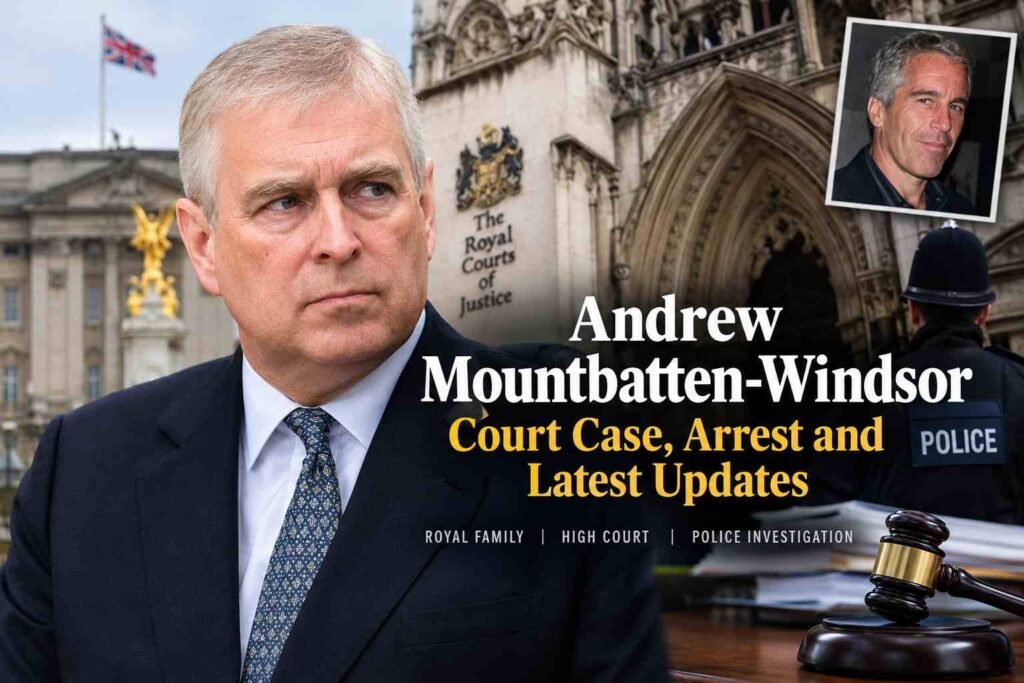
Andrew Mountbatten-Windsor: Former Prince Andrew’s Legal Challenge
Andrew Mountbatten-Windsor is back in the headlines after taking legal action against Thames Valley Police. His challenge targets the search warrants that were used in the investigation leading to his arrest earlier this year.
Once known as Prince Andrew, he has gone by Andrew Mountbatten-Windsor since his royal titles and honours were stripped. He has now asked the High Court to decide whether police acted lawfully when they secured warrants to search properties linked to him. A private hearing is set for Thursday, October 8, 2026.
The case adds to a controversy that has dragged on for years, one tied to his friendship with convicted sex offender Jeffrey Epstein and to questions about how he behaved while serving as a UK trade envoy.
The present court proceedings are only about whether the warrants and police actions were lawful. Andrew has not been convicted of anything connected to the investigation, which is still open. After his February arrest, he was released under investigation.
This article covers who Andrew is, why he is in court, what took place at his arrest, what police are looking into, and what could come next.
Who Is Andrew Mountbatten-Windsor?
Andrew is the former Prince Andrew, the younger brother of King Charles III and the second son of Queen Elizabeth II and Prince Philip. For most of his life he was known as the Duke of York. He took part in official royal engagements and carried out public duties for many years.
He also built a profile in trade and diplomacy. From 2001 to 2011 he was the UK’s special representative for international trade and investment, a job that put him in regular contact with business leaders, investors and politicians across the globe.
That earlier role now matters a great deal. The police inquiry that led to his February 2026 arrest centers on his conduct while he held it.
Why Is Andrew Mountbatten-Windsor in the News Now?
The reason for the current surge in coverage is his move to contest the warrants police used to search properties connected to him. Reports say he has brought proceedings against Thames Valley Police and wants the High Court to look at whether those warrants were legal.
The warrants were granted before his February arrest. They allowed officers to search properties linked to him, among them Royal Lodge and a property on the Sandringham Estate. A judicial spokesperson has confirmed that the hearing is listed for Thursday.
It is expected to be held in private, at least at the start, and the question of who may see the court papers is also part of the proceedings. That explains the spike in searches for Andrew Mountbatten-Windsor court, Andrew Mountbatten-Windsor legal action, Andrew Mountbatten-Windsor arrest, and Prince Andrew court case.
Andrew Mountbatten-Windsor Court Case: What Is He Challenging?
This is not a hearing about his personal affairs or his lifestyle. It is about the warrants police obtained before arresting him. Andrew is asking for a judicial review. In plain terms, he wants a judge to decide whether the legal conditions for granting the warrants were actually met.
The detailed arguments and evidence are part of the court process, and some of the material is being held back from the public. According to reports, Thames Valley Police got the warrants from the Central Criminal Court, and they covered searches of properties tied to Andrew.
The challenge could end up shaping the wider investigation, since the result might affect how any evidence found in those searches is handled. Even so, contesting a warrant does not settle whether the underlying allegations are true. It is a separate question.
Keeping that difference in mind is essential when following the Andrew Mountbatten-Windsor investigation.
Why Was Andrew Mountbatten-Windsor Arrested?
He was arrested in February 2026 on suspicion of misconduct in public office. The allegations relate to what he did while serving as a UK trade envoy.
Police are looking at claims that he may have passed confidential government information to Jeffrey Epstein. Andrew was later released under investigation, and no charge has been brought in connection with the inquiry. The arrest carried extra weight because of where Andrew once stood in the Royal Family.
At the time, King Charles said the law should take its course, a sign that royal status would not shield Andrew from scrutiny. It was also an extraordinary episode in modern British royal history, given that the man arrested is the brother of the reigning monarch.
What Is the Jeffrey Epstein Connection?
Andrew’s name has been linked with Epstein for years. The police inquiry, though, looks at one narrow part of his past: how he acted while working as a UK trade representative.
Newly released documents and emails have sharpened the focus on his dealings during those years. Reports describe emails that allegedly show Andrew asking government officials for confidential information and then passing details to a business contact. That material has become relevant to the police inquiry.
The emails have also prompted questions about what the British authorities knew, and when. One striking revelation was that an archive of thousands of emails connected to Andrew’s finances had reportedly been handed to Buckingham Palace in 2020.
That detail has added yet another layer to the debate over Andrew and his former royal life.
What Happened to Andrew Mountbatten-Windsor’s Royal Titles?
The name Andrew Mountbatten-Windsor came into wide use after Buckingham Palace announced in October 2025 that it had begun a formal process to remove his royal style, titles and honours.
The Palace said he would from then on be known as Andrew Mountbatten Windsor. The same statement said formal notice had been served over his lease on Royal Lodge, and that he was expected to move into other private accommodation. It was a sharp fall from his earlier position.
For decades the public knew him as Prince Andrew, Duke of York. After the Palace’s decision, coverage gradually switched to Andrew Mountbatten-Windsor, or simply Andrew Mountbatten Windsor. That shift is why the newer name is now such a common search term.
Andrew Mountbatten-Windsor and Royal Lodge
Royal Lodge has been tied to Andrew for a very long time.
The Windsor property became a central part of the dispute over where he would live once he lost his royal status. It also entered the police inquiry, because officers searched it under warrants obtained as part of the investigation.
Royal Lodge has therefore become a meeting point for several storylines in his post-royal life: his housing, his strained relationship with the Royal Family, and the open police inquiry. The house draws heavy media interest as well, thanks to its closeness to Windsor Castle and its long link with the monarchy.
What Is Misconduct in Public Office?
A key legal term in the coverage is misconduct in public office. It is an offence linked to serious wrongdoing by someone who holds or carries out a public role. Whether an offence has taken place depends on the facts and the relevant law.
In Andrew’s case, police are examining claims connected to his past role as a UK trade envoy and to the handling of confidential information. An investigation is not a conviction, and the two should never be confused.
Right now, Andrew has been arrested on suspicion and investigated. He was released under investigation, and current reports give no indication that he has been convicted. Writers covering the Andrew Mountbatten-Windsor court case need to keep that line clear.
What Is Thames Valley Police Investigating?
Thames Valley Police is the force leading the inquiry.
After Andrew began his legal challenge, the force confirmed that it was involved in proceedings over warrants it had earlier obtained from the Central Criminal Court. Because the case is before the courts, police gave little additional comment. The inquiry is reported to focus on Andrew’s behavior during his time as a trade envoy.
Officers have carried out property searches and reviewed documents as part of their work. The investigation has also drawn on information that surfaced in papers connected to Jeffrey Epstein. With the inquiry still active, many details are unsettled.
What Happened During Andrew’s Arrest?
Andrew was arrested in February 2026.
Reports say he spent roughly 11 hours in custody before being released under investigation. The arrest drew huge international attention because of his former place in the Royal Family. Pictures of him leaving a police station spread quickly across the media.
The scene was remarkable: a former senior royal under police investigation over alleged conduct linked to a government-related trade post. Still, the principle was the same as for anyone else. An arrest on suspicion does not amount to a finding of guilt.
Andrew Mountbatten-Windsor and the High Court
The High Court is now where the latest phase of this dispute will play out. Andrew’s lawyers are contesting the warrants that came before the searches. A judicial review lets a court check whether a public body acted lawfully and followed the right legal process.
Here, the main issue is whether the police warrants were legally sound. The hearing is expected to be closed to the public, and the court is also handling limits on access to some documents.
As a result, the public may not get the full picture of the arguments or the evidence straight away.
Why the Court Challenge Matters
There are several reasons the Andrew Mountbatten-Windsor court proceedings carry weight. For one, they may decide whether the warrants used to search his properties were valid in law. For another, the outcome could affect how evidence collected in those searches is treated.
The case also tests how Britain’s legal system deals with an investigation involving someone so closely connected to the monarchy. And it could shape how the public understands the wider inquiry. If the court turns down Andrew’s challenge, the police investigation can carry on and the warrants stay in place.
If the court finds serious flaws in the warrants, parts of the investigation could be affected. What those effects would be depends on the ruling itself and the circumstances.
Andrew Mountbatten-Windsor and the British Royal Family
Andrew’s place within the Royal Family has changed dramatically in recent years.
He withdrew from royal duties in 2019, after fierce criticism over his links to Epstein and a BBC interview that was widely condemned.
Later he lost his military titles and royal patronages.
In 2025, Buckingham Palace announced more steps, including the removal of his titles and honours.
His 2026 arrest and the continuing inquiry have opened another painful chapter for the monarchy.
King Charles has stressed that the legal process must run independently.
That stance fits the Palace’s wider effort to keep the institution at a distance from the controversy surrounding Andrew.
Andrew Mountbatten-Windsor’s Remaining Honours
Even after many royal titles and honours were taken away, some civic distinctions were still in question.
One example is the Freedom of the City of London.
In September 2026, the City of London Corporation approved a legal process that could lead to the honour being withdrawn. It said the process would move forward urgently and that Andrew would be able to submit written representations before any final decision.
The matter shows how the fallout from his controversy has spread beyond Buckingham Palace.
Decisions about his standing are increasingly being made by bodies outside the Royal Family.
What Happens Next for Andrew Mountbatten-Windsor?
The next event is the High Court hearing set for Thursday.
The court will look at Andrew’s challenge to the police warrants.
Holding the hearing does not mean the broader investigation will be wrapped up.
According to Thames Valley Police, its inquiry is still going.
There are a few ways things could go.
- The court could reject the challenge
If the court decides the warrants were lawfully granted, Andrew’s challenge would fail.
The police investigation would then go on as before.
- The court could find problems with the warrants
If the judge finds the warrants were not lawfully obtained, they might be quashed.
What that would mean in practice would turn on the precise ruling and the evidence involved.
- The investigation could continue regardless
Even a partial win for Andrew would not automatically end the whole inquiry.
Police might still be able to pursue other evidence or other lawful lines of investigation, depending on the circumstances.
- Further legal proceedings could follow
With the inquiry still open, more hearings or legal challenges could come.
For that reason, the October 2026 hearing is best seen as one stage in a much longer legal story, not its last chapter.
Andrew Mountbatten-Windsor: Latest News Explained
The newest development matters because Andrew is now going head to head with the police action that led to searches of his properties.
Reuters reported on October 5 that he had asked a judge to examine the lawfulness of the warrants that came before his February arrest. The Associated Press also reported that he had filed a High Court claim contesting warrants that authorized searches of two residences.
The Guardian reported that the former prince is questioning whether Thames Valley Police acted lawfully in obtaining and using the warrants. Taken together, these reports show that the story has moved on from his lost royal status and into a live legal fight involving the police and the courts.
Andrew Mountbatten-Windsor Timeline
2001–2011: UK Trade Envoy
Andrew held the post of the UK’s special representative for international trade and investment.
2019: Withdrawal From Royal Duties
He stepped away from public royal duties after the uproar over his relationship with Jeffrey Epstein and the damage done by his BBC interview.
2020–2022: Email Archive Controversy
Court documents later showed that an archive of thousands of emails linked to Andrew’s finances had been given to Buckingham Palace.
October 2025: Royal Titles Removed
Buckingham Palace launched a formal process to remove his style, titles and honours, and said he would be known as Andrew Mountbatten Windsor from then on.
February 2026: Arrest
He was arrested on suspicion of misconduct in public office as part of the inquiry into his conduct as a former trade envoy.
He was later released under investigation.
2026: Police Investigation Continues
Thames Valley Police kept investigating the allegations tied to his former role.
October 2026: High Court Challenge
Andrew began legal proceedings contesting the search warrants connected to the investigation.
October 8, 2026: Scheduled Hearing
A private High Court hearing is listed to consider the challenge.
What Does This Mean for King Charles?
The situation puts yet another strain on King Charles and the monarchy as a whole.
Andrew is the King’s younger brother, but the Palace has been stressing the gap between him and the working Royal Family. Taking away Andrew’s titles and honours was a major institutional break. This legal dispute is a fresh test, since it involves British law enforcement and the courts.
The King has already said that the law should take its course after Andrew’s arrest. That means the monarchy is unlikely to play any formal part in deciding how Andrew’s challenge turns out.
What Should Readers Understand About the Allegations?
The allegations are serious, but reporting on them demands a careful split between claims, investigations and established facts.bAndrew has been arrested on suspicion of misconduct in public office. Police are looking into claims involving confidential information and his past role as a UK trade envoy.
Current reports do not say he has been convicted of the offence. The High Court action now underway is about whether the search warrants were lawful. So readers should not take the legal challenge as proof that he did something wrong, nor as proof that the allegations are baseless.
The court will deal only with the legal questions put in front of it.
Why This Story Is Receiving Global Attention
A number of factors keep the Andrew Mountbatten-Windsor story in the spotlight worldwide.
His Royal Background
For decades Andrew was a senior figure in the British Royal Family.
His Relationship With Epstein
His connection to Jeffrey Epstein has faced international scrutiny for years.
The Police Investigation
The 2026 inquiry looks at conduct allegedly tied to his former official role.
The Arrest
Seeing a former senior royal arrested was an extraordinary moment.
The High Court Challenge
Andrew is now contesting police action in court.
The Constitutional and Institutional Questions
The case touches on bigger issues of accountability, privilege and how the monarchy relates to Britain’s legal institutions.
Together, these reasons explain why Andrew Mountbatten-Windsor remains one of the most searched royal names in the news.
Frequently Asked Questions About Andrew Mountbatten-Windsor
Who is Andrew Mountbatten-Windsor?
He is the former Prince Andrew and the younger brother of King Charles III. Since the removal of his royal titles and honours, he has been known as Andrew Mountbatten Windsor.
Why is Andrew Mountbatten-Windsor in court?
He is contesting the search warrants Thames Valley Police obtained in the investigation that preceded his February 2026 arrest. A High Court hearing is listed for October 8, 2026.
Why was Prince Andrew arrested?
He was arrested on suspicion of misconduct in public office, over allegations about his conduct while serving as a UK trade envoy. He was released under investigation and has not been convicted of the allegation.
Is Andrew Mountbatten-Windsor still a prince?
No. In October 2025, Buckingham Palace announced that the formal process to remove his style and titles had started, and that he would be known as Andrew Mountbatten Windsor.
What is the connection between Andrew and Jeffrey Epstein?
Andrew has had a well-publicized association with Epstein for years. The current police inquiry concerns allegations about his conduct as a UK trade envoy, including claims about confidential government information.
Has Andrew Mountbatten-Windsor been charged?
Current reporting says he was arrested and released under investigation. An ongoing investigation does not mean he has been convicted.
What happens next?
The next step is the scheduled High Court hearing on his challenge to the search warrants. The wider Thames Valley Police investigation is still under way.
Final Thoughts
Andrew Mountbatten-Windsor has reached another turning point, as he disputes the legality of the police search warrants tied to his February 2026 arrest. The coming High Court proceedings may shed light on how those warrants were obtained and whether police followed the proper legal steps.
Meanwhile, the broader investigation has not been resolved. Andrew has not been convicted of the allegations being examined, and his legal challenge should not be read as a final verdict on them. Still, the outcome in court could carry real consequences for the next phase of the inquiry and for how the story of the former Prince Andrew continues to unfold.
For now, attention rests on the Andrew Mountbatten-Windsor court case, Thames Valley Police, the validity of the search warrants and the continuing inquiry into events linked to his former role as a UK trade envoy. As the High Court weighs the challenge, new developments could show whether the investigation stays on its present course or runs into further legal complications.