Sailors Rescued After Whale Collision: Four Crew Members Survive
Four sailors have been rescued after their yacht was badly damaged and sunk by a whale incident in the South Pacific, which has now attracted international attention.
The yacht, Tai Tam, which was flying the Australian flag, was under way in the waters north of Norfolk Island when it collided with a whale and started to fill with water. At the end of the day, the four-man crew found they had to evacuate the vessel and board a life raft.
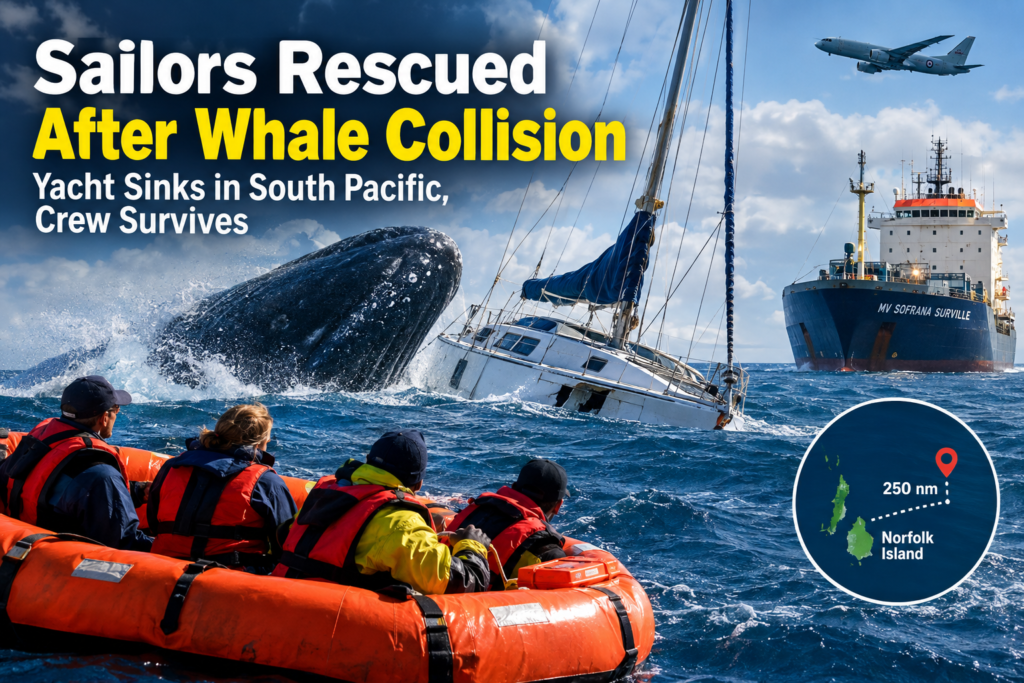
At around 6 am on 27th of September 2026, the 143 m cargo ship MV Sofrana Surville located the sailors in open water and rescued them. A Royal New Zealand Air Force P-8A Poseidon aircraft was also sent to search for the crew and to maintain communications for the rescue.
The incident has brought the risks of yacht/whale collision to the forefront, the value of emergency equipment and the potential problems that can be experienced during a major yacht structural damage in an area far from land.
A recap of what happened, how the sailors escaped and what the rescue has taught us about preparedness at sea.
What Happened to the Sailors After the Whale Collision?
It happened on the Tai Tam, which is an Australian flagged yacht about 51′ in length.
The Maritime New Zealand and New Zealand Defence Force states the yacht was found to be around 250 nautical miles (nm) north of Norfolk Island when it hit a whale. The effect made the ship leak, and eventually the four sailors had to leave the yacht.
Following the collision, the crew activated an Emergency Position-Indicating Radio Beacon (EPIRB).
Maritime New Zealand’s Rescue Coordination Centre received the distress signal and started co-ordinating a response.
A life raft was brought aboard the sailors and other vessels were sent to the area. A Royal New Zealand Air Force P8A Poseidon surveillance plane was sent to help.
The aircraft found the people who were alive and set up a two-way radio link.
The sailors waited in the life raft until the 143m cargo ship MV Sofrana Surville arrived to pick them up and take them away, where all four sailors survived.
The four sailors were said to be safe on the cargo ship.
Where Did the Whale Collision Happen?
The Tai Tam whale collision took place in isolation in the remote South Pacific, 250 nautical miles north of Norfolk Island.
Norfolk Island is an Australian external territory located in the Pacific Ocean between Australia, New Zealand and New Caledonia.
The area where the accident occurred was significant given the yacht’s remote access to land-based help.
The waves at the time were up to around two metres, Maritime New Zealand said.
Sailors who have a yacht that is rapidly taking in water can find distance from shore to be a life or death situation.
Here, an emergency beacon and rescue coordination and the presence of commercial shipping nearby were significant factors that facilitated safe rescue.
The Tai Tam Yacht Was Forced to Abandon Ship
The whale hit the yacht and it started taking on.
The crew tried to handle the damage and to keep the yacht afloat. The sailors reported that the collision had caused serious damage, including issues with the steering and water getting in through breaches.
The crew remained at work to ensure that the yacht would stay afloat until help arrived.
But the damage became too severe.
At one time the sailors decided they wanted to abandon the yacht and board a life raft.
This is one of the biggest events in the tale as giving up a boat is a critical choice for any offshore sailor. A break in the hull of a yacht may sometimes be a better option than a life raft, but if it is sinking rapidly it can become a growing threat.
Finally the crew moved to the raft and awaited rescue.
How the Sailors Were Rescued?
The rescue operation included a number of organizations and vessels.
Maritime New Zealand’s Rescue Coordination Centre (RCC) was called upon to coordinate the emergency by receiving the EPIRB alert.
A Royal New Zealand Air Force P-8A Poseidon was dispatched to help. The aircraft was able to arrive at the location of the crew and communicate with them.
Meanwhile, vessels in the surrounding area were alerted and some were diverted to help.
The MV Sofrana Surville was the first ship to arrive at the survivors.
The sailors were in the life raft for several hours before the arrival of the cargo ship at about 6 a.m. on September 27, according to the New Zealand Defence Force.
All four sailors were brought aboard safely.
The rescued crew were then transported toward the nearest port for disembarkation.
Maritime New Zealand’s Rescue Coordination Centre Operations Manager Mike Clulow commended the co-ordination between the agencies and vessels involved, including the early response from the crew to use the emergency beacon.
Who Were the Four Sailors?
Two of the four crew members were Australians, one New Zealander and one French national, 1News reported. The collision and aftermath was described by Australian sailors Jeremy and Jemma Cooper. The impact took place under the leadership of Jemma Cooper. She recalled a tremendous blow which forced the yacht to the side and made its steering gear inoperable.
When the collision occurred, Jeremy Cooper was below deck, where he immediately realised that it was serious. The crew worked together to survey and try to stem the flooding, before it was decided that the yacht was not going to be salvaged.
New Zealand sailor Terry Hetherington also said that he heard an extremely loud bang when the yacht struck the whale. Their reports give a better idea of how fast a seemingly unremarkable sailing voyage could become a sea emergency.
Was It a Sperm Whale?
The sailors reported seeing a whale pod close to the yacht. Subsequent reports indicated that the beast in question was a sperm whale, though it was not reported that any independent evidence exists that the whale intentionally rammed the yacht.
According to CBS, citing AFP, the crew saw a pod of around six to eight whales and thought that it was a sperm whale that was involved in the crash. That distinction matters. A whale collision does not necessarily mean a whale intentionally attacked a boat.
Large whales may come up on our boats at any time and if their paths cross with the boat a collision can happen. Shortly after the impact, the crew of the yacht reported sighting whales around the yacht. There is no definitive reporting to show the animal intentionally hit the yacht.
How Much Damage Did the Whale Cause?
It caused damage that was so extensive as to eventually sink the yacht. Sailors reported damage to the hull and steering gear, with large amounts of water in the vessel.
As the structure of the yacht became damaged, and her steering was lost, she became harder to handle and harder to keep afloat. The crew is reported to have tried to slow the flood and keep the ship afloat as long as possible. However, its harm was too great.
The Tai Tam went down and the four sailors were left on their life raft with their rescue gear. This incident illustrates the potential dangers of a comparatively brief collision at sea. While a large vessel can sustain damage and still survive a collision, a smaller sailing yacht may sustain catastrophic damage if a collision occurs with the underwater components of the vessel – such as the keel, rudder or hull.
Why the EPIRB Was So Important?
The prime teaching point from the sailors who were rescued from the whale collision case is the value of an EPIRB. An Emergency Position-Indicating Radio Beacon is a radio beacon used to transmit an emergency signal that may facilitate the rescue of a vessel when an emergency occurs.
This incident, the crew of the Tai Tam activated the EPIRB after the collision. That signal was passed to Maritime New Zealand’s Rescue Coordination Centre and began to coordinate assistance. The New Zealand Defence Force and Maritime New Zealand highlighted how critical the early response to the EPIRB activation was to the rescue.
For those who sail offshore, this may be an essential piece of safety gear. If the vessel is sinking, it can become difficult to communicate, visibility may be limited and survivors can be easily disoriented. An emergency beacon can give rescuers helpful information in locating the area to search.
The Role of the Royal New Zealand Air Force
The P-8A Poseidon, also from the Royal New Zealand Air Force, was also a part of the rescue. It was not just to find the yacht, but to find the yacht and to locate it so quickly that it could not be seen from the ground.
The New Zealand Defence Force reported that the crew of the P-8A found the crew of the sailors and set up two-way radio contact with them. The aircraft also assisted in coordinating with ships in the area which could help. This sort of coordination can be useful in the remote ocean areas, especially.
A patrol aircraft will be able to cover a vast area much quicker than a surface vessel and commercial ships will be able to physically board survivors with a large capacity. In the case of Tai Tam, these different capabilities collaborated. The aircraft was used to search for and communicate with survivors, and the cargo ship eventually took them off.
MV Sofrana Surville Rescues the Crew
The ship which finished the rescue was a cargo ship known as the MV Sofrana Surville, which measured 143 m in length. The ship was around the area when the rescue coordination system diverted ships to the stranded sailors.
It eventually arrived at the life raft around 6 am. They embarked the sailors safely, and they sailed to port where they could get off. The four survivors were fortunate to see a large commercial ship approaching their tiny lifeboat when their waiting period began.
The rescue also illustrates the important role that commercial shipping can play in maritime emergencies. Recreational boaters occasionally find themselves in the middle of a big commercial vessel that is traveling through a remote region where they are not able to get immediate help.
How Long Were the Sailors in the Life Raft?
There is some variation on how the wait is described and it is estimated to be about 17 to 18 hours from the collision and emergency response to the eventual rescue.
The crew in the life raft had been in the boat for about 17 hours before departing, according to 1News, and about 18 hours according to CBS and AFP.
The discrepancy may be because of the different way the timing is computed.
Regardless of the exact figure, the crew spent a prolonged period offshore after abandoning their yacht.
They were exposed to open-ocean conditions and had to rely on their life raft, emergency communications and rescue coordination.
No matter what the number is, the crew had to spend a long time out at sea after having cast aways.
Why Whale Collisions Can Be Dangerous for Small Boats?
They were forced to face open sea and had to depend on their life raft, emergency communication and rescue setup.
When a whale and a vessel collide, the consequences depend on several factors, including:
- The size of the whale
- The size and construction of the vessel
- The speed of the vessel
- The location of the impact
- Whether the collision affects the hull
- Whether the rudder or steering system is damaged
- Sea conditions
- Distance from land or other vessels
For a sailing yacht, damage below the waterline can be especially dangerous.
Even if the vessel initially remains afloat, flooding can increase rapidly.
Damage to steering can create another problem, as a boat that can’t steer may not be able to clear additional hazards or position the boat to be rescued.
Are Whale Collisions Common?
One of the major concerns about whale collisions with boats is that they have the potential to impact marine mammals as well as boats.
However, serious collisions involving small recreational boats are not everyday events. According to the Washington Post, there were some 1200 incidents recorded in a worldwide database started in 2007, with only some whale-and-boat collisions resulting in “significant damage.
Whales may be of particular concern in areas where they are known to regularly travel, feed or migrate. Whales are among the most spectacular experiences for sailors when they are on the ocean. Meanwhile, they must be recognised as present so that the movements of big marine mammals can be predicted.
Whale Safety Is Also About Protecting the Animals
Whale collisions pose not only a danger to humans and vessels, but they also pose a danger to the whale. Whales can be severely injured or even die from being struck by a vessel.
This is particularly of concern to large whale species that migrate through dense shipping lanes. The problem has been investigated elsewhere in the world – on the coast of the USA and other seas that have extensive marine traffic.
Vessel strikes are recognized as an important issue in conservation by the International Whaling Commission and other marine organizations. Whale collision prevention is thus for two reasons: protecting people in the water and minimising damage to marine life.
What Sailors Can Learn From the Tai Tam Rescue?
The Tai Tam whale collision provides several practical lessons for anyone planning offshore sailing.
1. Carry a reliable emergency beacon
The early activation of the crew’s EPIRB assisted with the identification of the emergency and the co-ordination of the response.
In offshore sailing, emergency communication gear is a must-have.
2. Know how to abandon ship
Departing a yacht is never a typical choice.
Members of the crew should be familiar with the location of life rafts, life jackets, emergency beacons, radios and other safety equipment.
All personnel on board should be familiar with the operation of the equipment.
3. Maintain emergency communication
A distress beacon is only one part of an offshore emergency plan.
Other suitable means of communication, such as VHF radio, satellite radio etc. can be used to assist the rescue authorities.
4. Keep life-saving equipment accessible
In case of emergency, it may not be possible to open storage compartments.
There should be life jackets, emergency beacons, radios and raft equipment available.
5. Pay attention to whale activity
When sailing through areas known for whale activity, crews should maintain a good lookout.
Whales can come up on their own and it’s important to be situationally aware.
6. Prepare for the possibility of flooding
Crews should take a good lookout when passing through whale watching areas.
Pumps, damage-control materials, plugs and other emergency repair equipment can provide additional time.
The crew on board Tai Tam apparently tried to keep the boat afloat before giving up and leaving it.
What Happened to the Tai Tam Yacht?
The yacht could not be saved.The crew was forced to leave the ship and proceed to the life raft and finally the Tai Tam sank under the waters of the South Pacific.
The sailors were already told from reports that the yacht was unsalvageable. Then it was all about getting the four people out of the water safely until rescued.
The loss of the yacht ended what had otherwise been a recreational sailing journey. But all four crew members survived the accident.
A Rescue That Highlights the Importance of Preparation
Finally, the tale of the sailors who were rescued after whale collision is one of preparation and concerted emergency response.
The whale strike was an unusual occurrence.
The yacht was badly damaged.
The crew were forced to leave their ship.
They then spent hours in a life raft in a remote section of the Pacific.
Given those conditions, the crew’s emergency beacon gave rescue authorities a first indication of their location, the P-8A Poseidon assisted with location and communication, and the MV Sofrana Surville was able to locate the crew, and take them aboard.
Maritime New Zealand really spoke up about the crew’s preparation and early use of the EPIRB.
Other local vessels, New Zealand Defence Force and the Joint Rescue Coordination Centre in Australia also assisted in the rescue.
Other Recent Whale-and-Boat Incidents
The Tai Tam incident follows a number of other whale-related boating accidents which were widely reported in the media.
In July 2026, a whale rammed into a New Jersey fire department boat, which sank and was retrieved by local residents, the CBS reports.
In July 2026, another whale struck a 25 foot sailing boat at anchor in Glacier Bay National Park in Alaska. The family on board rescued themselves and fled to shore, while the ship sank in minutes, the reporting was read in August.
Four sailors on board the 44-foot-long Raindancer were rescued from the Pacific after their sailboat was hit by a whale and sank on a journey from the Galápagos Islands to French Polynesia in 2023.
Although there are many differences in the circumstances, location and type of vessel involved in these incidents, they have one thing in common: encounters between large marine mammals and boats can sometimes have serious consequences.
Frequently Asked Questions About the Sailors Rescued After Whale Collision
How many sailors were rescued after the whale collision?
The Australian flagged yacht, Tai Tam had hit a whale and was taking on water off the coast of Norfolk Island before four sailors were rescued. The crew consisted of two Australians, one New Zealander and one French.
Where did the yacht hit the whale?
The crash occurred at an altitude of around 8,000 feet about 250 nautical miles north of Norfolk Island in the South Pacific. It was also reported that the yacht was about 185 miles southeast of Nouméa, New Caledonia.
What ship rescued the sailors?
The 143-meter long cargo ship MV Sofrana Surville arrived at the time of the rescue at around 6 a.m. on September 27th, 2026.
How did rescuers locate the sailors?
The crew activated an EPIRB which triggered an emergency alert picked up by Maritime New Zealand’s Rescue Coordination Centre. A Royal New Zealand Air Force P-8A Poseidon aircraft was then deployed and the sailors were found.
Did the sailors survive?
Yes. The four sailors were rescued and made it up on the cargo vessel safe. They were then moved to a port for disembarkation.
What happened to the Tai Tam yacht?
After the whale crash, the yacht suffered serious damage and started filling with water, and was finally abandoned by its crew. The ship later went down.
Was the whale identified?
The sailors reported a pod of whales which was later identified as a sperm whale. However, the available reports do not show that the whale deliberately rammed the yacht.
Final Thoughts
Sailors evacuated after a whale collision in the South Pacific were rescued from an extraordinary situation after their yacht was damaged and eventually sunk after running smack into a whale.
The case also demonstrates why offshore sailors need to prepare for emergencies that can develop with little warning. The Tai Tam crew’s EPIRB activation, life raft and emergency procedures gave rescuers critical information and helped keep the sailors alive until a vessel could reach them.
Most importantly, all four sailors survived.
For people who spend time offshore, the incident is a reminder that the ocean can change quickly—and that emergency preparation, reliable communication equipment and coordinated rescue services can make a critical difference when a routine voyage suddenly becomes a fight for survival.