ASOS Hacked? What We Know About the Snowflake Breach
The “ASOS hacked” story is trending after customers of the online fashion retailer reportedly got an alarming push notification through the ASOS app on Tuesday, October 6, 2026.
It looked nothing like a normal shopping alert, sale promotion, order update or customer-service message. It reportedly carried the title “ASOS HACKED” and claimed that attackers had broken into an ASOS Snowflake instance.
The message was apparently aimed at the company’s data protection officer and IT team, and it threatened to leak information unless the attackers were contacted through a Telegram link. Several media outlets said they saw or received the notification, and customers posted screenshots and reactions online.
What Happened With the ASOS Hacked Notification?
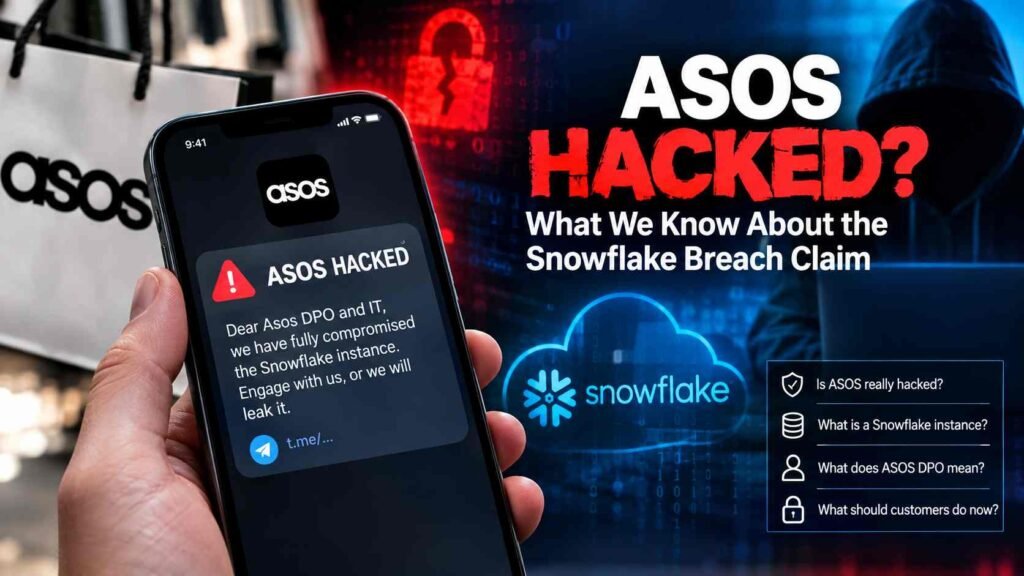
It all started on the morning of October 6. ASOS app users reportedly saw a push notification with the words “ASOS HACKED.” The text went on to say the attackers had taken over the company’s Snowflake instance and would leak data if ignored.
The notification reportedly read: “Dear Asos DPO and IT, we have fully compromised the Snowflake instance. Engage with us, or we will leak it.”
A link was also attached, pointing recipients to a Telegram account or channel said to belong to the attackers.The wording drew attention straight away because it seemed written for ASOS’s internal security and privacy staff, not for everyday shoppers.
The term DPO matters here. It usually stands for Data Protection Officer, the person who helps an organization meet its data-protection duties and keeps an eye on privacy compliance.
ASOS says on its own site that it has a Data Protection Officer and a dedicated Data Protection Team that handle privacy matters and look into possible data breaches. That does not prove the message came from genuine attackers, but it explains why the wording got so much notice.
Has ASOS Been Hacked?
In short, an alleged ASOS hack is being reported and looked into, but a full breach has not been officially confirmed.
That difference matters.
Several large outlets covered the notification and the claimed Snowflake compromise. Reuters said ASOS shares dropped by more than 11% once the reports spread, and that it could not independently check the hacking claims. Reuters also said an ASOS spokesperson knew about the reports but did not confirm the incident.
TechRadar likewise noted that ASOS had issued no breach notification when its article went live. So headlines saying “ASOS hacked” should for now be read as describing an alleged or suspected cyberattack, not a fully confirmed account of events.
That could change fast if ASOS admits unauthorized access, names the affected systems, or says what happened to customer data.
What Is the ASOS Snowflake Instance?
A big reason this story has grabbed attention is the mention of a Snowflake instance. Snowflake is a cloud data platform that companies use to store, process and analyze huge volumes of information.
Depending on how a company sets it up, a Snowflake environment can hold valuable business data. Still, it would be wrong to assume that a Snowflake breach means all ASOS customer information was stolen.
The notification did not publicly establish:
- which database was accessed;
- how the attackers supposedly got in;
- how long they had access;
- how much data was taken;
- whether customer information was touched;
- whether payment details were exposed;
- whether passwords were exposed;
- whether the supposed attackers really hold any data; or
- whether their claims are true at all.
Those are some of the most important questions still waiting for answers.
Why Does the Snowflake Reference Matter?
The Snowflake mention stands out because cloud data environments have been hit in big cyber incidents before.
Security researchers point to the wave of attacks in 2024 that hit Snowflake customer accounts. In those cases, attackers used stolen credentials to get into corporate Snowflake environments, and some of the companies were then threatened with extortion. Cybernews noted that Ticketmaster and AT&T were among the organizations tied to the wider campaign.
None of that shows the ASOS incident happened the same way. It does explain why security watchers are taking the Snowflake claim seriously. The mistake to avoid is assuming that because Snowflake appeared in earlier high-profile incidents, ASOS must have been attacked with the same technique.
Investigators would need real evidence before drawing that conclusion.
What Does “ASOS DPO” Mean?
Another phrase people keep searching is ASOS DPO.
DPO stands for Data Protection Officer.
A DPO generally handles an organization’s privacy and data-protection responsibilities. Depending on the company and the country, that can include advising on legal obligations, monitoring compliance, helping respond to data incidents and liaising with regulators.
ASOS states on its privacy website that its Data Protection Officer reports to the board and that its Data Protection Team helps investigate breaches and support data-protection requirements.
By addressing the notification to the ASOS DPO and IT team, the senders seem to have wanted it to read like a direct warning to the people in charge of security and privacy.
Once again, that tells us something about how the message was worded. It is not proof that whoever wrote it really got into ASOS.
Why Did ASOS Customers Receive the Hacker Message?
This is among the strangest parts of the story.
Rather than posting a ransom demand on a website or sending an email, the alleged attackers seem to have used the ASOS app’s own notification system to reach customers.
If the notifications really went out through compromised ASOS infrastructure, it could mean the attackers gained some access to a system able to send push messages.
There are other explanations, though, and investigators would have to weigh them.
For instance, they may need to work out whether:
- ASOS’s own notification infrastructure was compromised;
- a third-party service linked to ASOS was breached;
- an administrator account was accessed;
- an internal communications tool was manipulated;
- the message came through an unrelated vulnerability;
- the notification was somehow spoofed; or
- there is another explanation altogether.
The key point is that an official-looking push notification does not reveal the whole attack path on its own.
That is why “is ASOS hacked?” can’t yet be answered with full certainty about the technical side.
Was ASOS Hacked Today?
Yes, “ASOS hacked today” has become a major search because the incident was reported on October 6, 2026.
Customers began noticing the odd notification in the morning. Sky News reported that close to 500 customers had flagged problems with the ASOS website on Downdetector shortly before 10am, though that does not show the problems were caused by the alleged hack.
LBC also reported complaints about problems around the same time and said thousands of users had received the notification.
With the timing so close, it was natural for customers to link the two.
But a website outage or a surge in error reports does not automatically point to a cyberattack.
A proper investigation would need technical proof tying the disruption to unauthorized access.
Did ASOS Confirm the Hack?
In the latest reports available when this was written, ASOS had not publicly confirmed that the alleged Snowflake compromise was real.
Reuters said an ASOS spokesperson told it the company was aware of the reports but would not confirm anything or add further comment.
That makes careful wording in current coverage especially important.
There is a gap between saying:
“ASOS was hacked.”
and saying:
“ASOS customers received a notification claiming the company had been hacked.”
Based on the evidence so far, the second statement is far safer and more accurate.
As the investigation moves forward, ASOS may share more about the notification, the affected infrastructure, customer accounts and any exposure of data.
Could ASOS Customer Data Have Been Stolen?
It’s possible, but there is no confirmed public evidence yet of exactly what data was taken in the October 6 incident.
The message from the alleged attackers mentions a Snowflake environment and threatens a leak. It gives no verified list of stolen datasets.
An online retailer might hold customer names, email addresses, delivery addresses, phone numbers, order histories and other account details.
That should not be read as a claim that all of those categories were exposed here.
The real impact depends entirely on which systems were accessed and what level of access the attackers got.
Customers should therefore be wary of social-media posts saying millions of records have already leaked, unless credible evidence backs them up.
Were ASOS Payment Details Exposed?
Nothing in the October 6 reports verifies that full payment-card details were stolen in the alleged Snowflake incident.
Customers shouldn’t assume their full debit or credit card numbers are exposed just because a retailer may have suffered a cyberattack.
Payment data can run through separate systems, payment processors and security controls, and what a retailer keeps on file may be limited or tokenized.
ASOS’s own security advice tells customers to watch their bank statements, report any transactions they don’t recognize and never share full card details by email or live chat.
Until ASOS gives specifics about the alleged breach, customers should steer clear of two extremes:
- Don’t assume there is no risk.
- Don’t assume every payment card has been compromised.
Staying cautious is the sensible response to a fast-moving security incident.
ASOS Had a Separate Account Security Incident Earlier in 2026
The October reports also arrive after a separate account security incident involving ASOS US earlier in 2026.
A breach tracker built from state regulatory filings said ASOS US Sales LLC told customers that unauthorized parties had logged into accounts in July using credentials obtained from outside sources. The information potentially involved included names, email addresses, delivery and billing addresses, phone numbers, redacted payment-card details, social-account information and dates of birth.
That earlier case was described as unauthorized access using credentials, and it does not back up the current Snowflake claims.
It’s important not to merge the two events into a single breach.
The July incident and the October 6 allegations are separate matters unless ASOS or investigators show a link between them.
What Should ASOS Customers Do Now?
Even with the full picture unclear, there are sensible precautions customers can take.
1. Change Your ASOS Password
If you’re worried about your account, change your ASOS password through the official website or app.
Pick a new password that is unique.
Don’t reuse one you already have for email, banking, social media or other shops.
ASOS itself recommends a unique password for your account and stresses avoiding reuse.
2. Change Reused Passwords Elsewhere
If your ASOS password is also in use on another site, change it there too.
This is one of the most valuable steps after any suspected account compromise.
A stolen password becomes far more dangerous when the same login details are used across several services.
3. Turn On Multi-Factor Authentication Where Available
Multi-factor authentication adds protection on top of a password.
If someone gets hold of your password, a second factor can make it much harder for them to log in.
Switch on MFA for your email, banking, social media and other key accounts wherever it’s offered.
4. Watch Your Bank and Card Accounts
Look through your financial accounts for transactions you don’t recognize.
ASOS suggests checking bank statements regularly and reporting anything suspicious to your payment provider.
That said, don’t panic over every charge just because of today’s headlines.
Focus on activity that is truly unauthorized.
5. Be Careful With “ASOS Hack” Emails
Security incidents create ideal conditions for phishing scams.
Criminals know that people searching for ASOS hacking news are more likely to click a message that claims to explain the breach.
A fake email might say:
- “Your ASOS account has been hacked.”
- “Verify your account immediately.”
- “Confirm your payment information.”
- “Claim your refund.”
- “Your order has been cancelled.”
- “Secure your ASOS account.”
Don’t click suspicious links.
ASOS warns that scammers pretend to be the company through social media, fake email addresses, WhatsApp and bogus websites.
6. Do Not Contact the Alleged Hackers
The notification reportedly included a Telegram link.
Customers shouldn’t follow it or engage with the alleged attackers.
An ordinary customer has no reason to negotiate with a cybercriminal group or hand over personal details.
Doing so could lead to more scams, malware or social-engineering attempts.
7. Keep the ASOS App Updated
ASOS advises keeping its app up to date, since updates can include security fixes.
Install official updates only through the regular Apple App Store or Google Play.
Never download an unofficial “security update” that arrives in an unknown message.
Should You Delete the ASOS App?
Deleting the app isn’t necessarily the most helpful first move.
If the incident involves your ASOS account, removing the app doesn’t delete the account or change your password.
A better plan is to:
- change your password;
- use a unique password;
- review your account activity;
- monitor your financial accounts;
- watch for suspicious emails;
- keep the official app updated; and
- follow official ASOS guidance as it appears.
If ASOS later tells customers to take a specific step, that advice should come first.
Is the ASOS Hacked Notification a Scam?
That remains one of the big open questions. The notification was reportedly delivered to real ASOS app users and covered widely by customers and news outlets. That makes this more worrying than an ordinary fake email floating around online.
Even so, a genuine notification doesn’t automatically prove that the underlying claim about a Snowflake compromise is true. Investigators must establish how the message got into the notification system and who approved or generated it.
The fact that it seems to have gone out through an official channel is exactly why the incident needs a thorough investigation.
Why Would Hackers Send a Message Directly to Customers?
There are a few possible strategic reasons.
Public pressure
A threat sent straight to customers can squeeze a company, since the incident becomes visible at once.
Reputation damage
A message in front of the public can spread fear among customers and draw press coverage.
Negotiation leverage
If the attackers really do hold stolen data, going public may be a way to push the company into talking to them.
Psychological impact
A message on your own phone feels more authoritative than an anonymous post on a hacking forum.
That effect can be powerful.
Still, these are general possibilities and not confirmation of what the ASOS senders were after.
What Could Happen Next?
The next stage of the ASOS investigation will likely focus on whether unauthorized access really happened and, if so, which systems were affected.
Key questions include:
- Was the Snowflake instance actually compromised?
- How did the alleged attackers get in?
- Was an employee or third-party credential involved?
- Was multi-factor authentication bypassed?
- What data could they reach?
- Was customer information downloaded?
- Was the notification system compromised?
- Were customer accounts affected?
- Has anything already been leaked?
- Did the attackers demand payment?
- Will regulators be told?
- Will affected customers be contacted directly?
The answers will show whether this was mainly a disruptive attack, a data breach, an account compromise, or a mix of these.
Why the ASOS Hack Matters Beyond Fashion
ASOS is a major international online retailer, so a security incident there has consequences beyond fashion shopping.
Modern retailers run on sprawling digital systems.
A typical online store may depend on:
- cloud data platforms;
- payment processors;
- customer databases;
- mobile apps;
- marketing systems;
- logistics platforms;
- third-party software;
- employee accounts;
- analytics tools;
- customer-service tools; and
- notification services.
An attacker doesn’t have to break into the main shopping site to do serious harm.
They might go after an employee account, a third-party service, a cloud environment or an admin system.
That is why the alleged ASOS Snowflake hack has caught the eye of security observers.
What Is Known and What Is Not Known?
A simple breakdown can help customers see where things stand.
| Question | Current status |
|---|---|
| Did customers receive an “ASOS HACKED” notification? | Reported by many customers and media outlets |
| Did the notification mention Snowflake? | Yes |
| Did it threaten to leak data? | Yes |
| Did it include a Telegram link? | Reported |
| Did ASOS officially confirm the Snowflake breach? | Not as of the latest reports |
| Has the exact stolen data been identified? | No |
| Are all ASOS customers confirmed victims? | No |
| Are full payment-card details confirmed exposed? | No |
| Was the exact attack method confirmed? | No |
| Is the investigation developing? | Yes |
This kind of clarity is especially valuable for SEO content, because breaking stories can change quickly.
ASOS Shares Fall After Hack Reports
The incident hit the share price right away.
Reuters reported that ASOS shares fell by more than 11% on October 6 after customers got notifications claiming the retailer had been hacked.
The Guardian also reported an 11.1% drop in ASOS shares during the morning’s trading.
The reaction shows how seriously investors take a possible cybersecurity incident.
A confirmed data breach can bring costs such as:
- incident response;
- forensic investigations;
- legal fees;
- regulatory compliance;
- customer support;
- compensation;
- security upgrades;
- reputational damage; and
- lost customer confidence.
At this point, though, it’s too early to say what the financial fallout will be.
ASOS’s Existing Cybersecurity Advice
ASOS already offers customers security guidance. Its cybersecurity page tells shoppers to use strong, unique passwords, keep the app updated, stay alert to phishing, protect their payment details and watch their accounts for suspicious activity.
The company also warns that scammers may pose as ASOS. Its customer-care advice says genuine ASOS messages should come from official ASOS-branded email addresses or verified social-media accounts.
That advice is especially relevant now, because an alleged cyberattack can set off a second wave of phishing attempts.
What Customers Should Watch for After the ASOS Hack News
Over the next several days, customers should be extra careful with unexpected messages.
Watch for:
Fake password-reset emails: A message may say your ASOS account has been compromised and ask you to click a link.
Fake refunds: Scammers may promise compensation for the alleged breach and ask for your bank details.
Fake customer support: Fraudsters may pretend to be ASOS staff and ask for passwords or verification codes.
Fake breach notifications: A convincing message may carry malware or send you to a fraudulent login page.
Social-media scams: Fake ASOS accounts may offer “support” to anxious customers.
ASOS specifically advises customers never to share passwords or card details through social-media messages.
What Does “ASOS Havked” Mean?
Some people searching “asos havked” are just misspelling “ASOS hacked.”
Typos are common in searches around breaking stories, since people type quickly after an alarming notification lands.
The question behind it is usually the same:
Has ASOS been hacked?
Right now, the most accurate answer is that ASOS customers received an official-looking notification alleging a major compromise, but the Snowflake breach claim had not been independently confirmed when the latest reports came out.
What Does “ASOS Hacked?” Actually Mean Right Now?
The question mark matters.
ASOS hacked?
That phrasing fits the current uncertainty. There is strong evidence that something unusual happened with the ASOS app’s notification system. Many customers have independently reported it.
There were reports of website problems around the same time. There is a specific claim about a Snowflake environment. There is a threat to leak information.
There was a sharp reaction from the market. But there isn’t yet enough publicly verified evidence to say exactly what happened inside ASOS’s systems. That distinction should stay clear until investigators or ASOS share more.
Frequently Asked Questions About the ASOS Hack
Has ASOS been hacked today?
Customers reported getting a notification on October 6, 2026, saying the company had been hacked and its Snowflake instance compromised. The full claim had not been independently verified or officially confirmed by ASOS in the latest reports.
Is the ASOS app hacked?
The app was reportedly used to deliver the unusual “ASOS HACKED” notification. That raises the question of whether part of the company’s notification infrastructure was compromised, but the technical mechanism hasn’t been confirmed.
What did the ASOS hacked message say?
The reported message was addressed to the ASOS DPO and IT teams. It said the attackers had fully compromised a Snowflake instance and threatened to leak information. It also reportedly contained a Telegram link.
Was ASOS customer data leaked?
A leak was threatened, but the latest reports did not show that a verified public dump of ASOS customer data had taken place. The type and amount of allegedly stolen information remain unclear.
Should I change my ASOS password?
Yes, it’s a sensible precaution, especially if you use the same password elsewhere. Choose a unique one and change it anywhere else you used it. ASOS itself recommends unique passwords.
Should I delete my ASOS account?
There’s no confirmed need for every customer to delete their account. Follow official ASOS security guidance, change reused passwords, monitor account activity and stay alert for phishing.
Was my credit card information stolen?
There is no confirmed evidence that full payment-card details were stolen in the alleged October 6 Snowflake incident. Keep an eye on your accounts, but don’t assume your card has been compromised.
What is an ASOS DPO?
DPO means Data Protection Officer. ASOS says it has a Data Protection Officer who oversees data protection, along with a dedicated data-protection team.
What is the ASOS Snowflake instance?
Snowflake is a cloud data platform. The reported hacker message claimed an ASOS Snowflake instance had been compromised. Which ASOS environment was involved, and how far any unauthorized access went, hasn’t been publicly established.
Final Thoughts on the ASOS Hacked Story
The ASOS hacked story is a developing cybersecurity incident that deserves attention, but customers should resist leaping from a frightening notification to conclusions about exactly what was stolen. Multiple reports confirm that ASOS users received a message claiming the company had been breached, naming an ASOS Snowflake instance and threatening a data leak. The underlying claim was still unconfirmed in the latest coverage, with Reuters saying it could not independently verify the reports and ASOS saying it was aware of them without confirming an attack.
For customers, the safest approach is simple: use a unique ASOS password, change any reused ones, monitor your financial accounts, avoid suspicious links and don’t engage with the alleged attackers. Above all, rely on official ASOS communications as more facts emerge. The biggest unanswered questions are whether the Snowflake environment was really compromised, what information may have been accessed and whether customer data was taken. Their answers will decide the true scale of the incident.