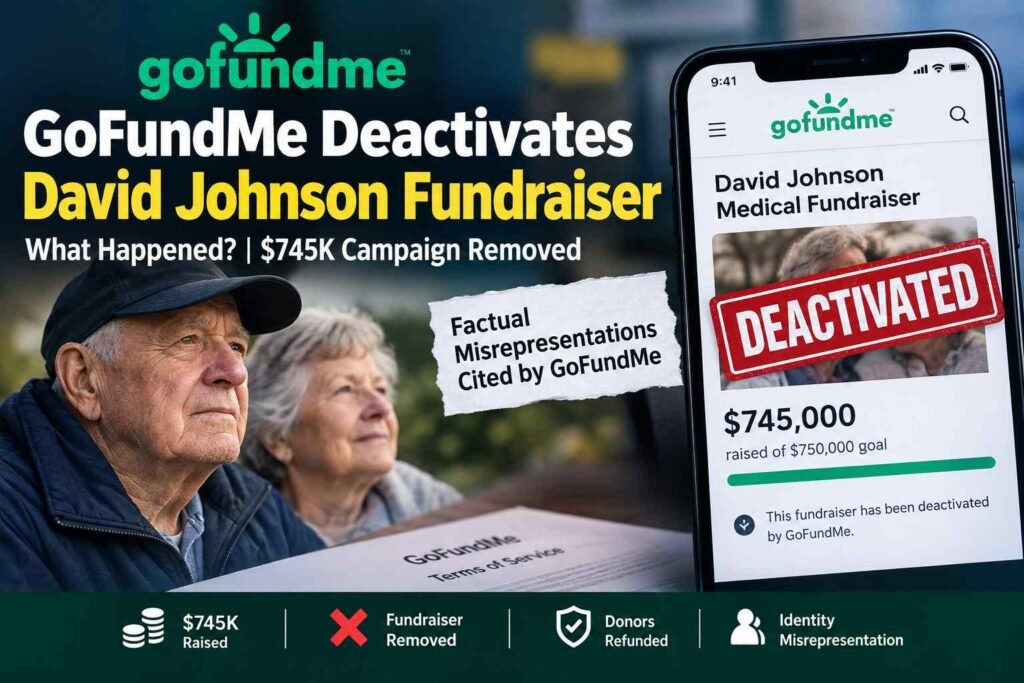
GoFundMe Deactivates David Johnson Fundraiser: What Happened?
GoFundMe Deactivates David Johnson Fundraiser
The David Johnson GoFundMe has gone awry after nearly $745,000 was raised for the treatment of his wife’s pancreatic cancer and GoFundMe ended up deactivating the fundraiser.
The fundraiser was pulled after NewsNation and several news sites reported that it was removed because of “factual misrepresentations” related to the fundraiser, according to a statement from GoFundMe’s Trust & Safety team.
The controversy is about the identity of the person who organized the fundraiser.
The woman who introduced herself as “Erin”, a neighbor was said to be actually David Johnson’s daughter. The out-of-the-family persona was created, she said, because she felt the family story would resonate with more donors if it was presented as from an outsider, not from a family member, in the family’s report on GoFundMe.
According to GoFundMe, it was a violation of its Terms of Service and was a way of hindering donors’ ability to know who they’re donating to when someone misrepresents the identity of the organizer. The company also indicated that the fundraiser was removed and that the donors were refunded.
The development has earned a lot of interest due to the number of dollars which had been raised before the campaign was removed.So far, here’s what we know about the David Johnson GoFundMe fundraiser, why it was deactivated and what happened to those donations.
What Happened to the David Johnson GoFundMe?
The David Johnson GoFundMe was established to fund the treatment of his wife’s cancer, which is being done by an 81-year-old man.
NewsNation reports that David Johnson had been working as a luggage courier at an airport about three years prior to help defray the cost of his wife’s treatment. He drove over 200,000 miles with regard to his job, according to the report.
The fundraiser was widely publicized and has reportedly raised nearly $745,000—the amount before GoFundMe took it down.
The campaign’s stated goal was to alleviate the financial strain of having to treat Johnson and his wife Josephine for pancreatic cancer.
In the end, however, as GoFundMe got a tip calling into question the identity of the woman running the fundraiser, the campaign was put under scrutiny.
According to the reports, the tip was received on September 25, 2026. The Trust & Safety team at GoFundMe then reviewed the campaign and the campaigner.
The case has been investigated and it was discovered that the person claiming to be a neighbor was Johnson’s daughter.That identity thing ended up being the major reason for the ousting of the fundraiser.
Why Did GoFundMe Deactivate the David Johnson Fundraiser?
The primary reason that GoFundMe cited was ‘factual misrepresentation.
A spokesperson for GoFundMe told NewsNation that the company’s Trust & Safety team had detected “factual misrepresentations” that directly infringed on the company’s TOS.
Importantly, the issue reported was not just because the organizer was a family member.
The issue was the organizer claimed to be a person who she wasn’t.
The name she used was “Erin” and she was listed as a neighbor, not as David Johnson’s daughter, she is reported to have said.
That’s important because people tend to give money to fundraisers they recognize and understand how they fit in with the charity they’re raising for.
Under current Terms of Service, organizations are responsible for making sure all information about their fundraisers is accurate, complete and clear. The terms also forbid users from pretending to be someone other than themselves or from claiming to belong to or be associated with someone else or some entity when they don’t.
In addition, the platform’s terms give it the power to investigate fundraisers and delete any campaigns it believes to be inaccurate, misleading, fraudulent or otherwise in violation of the terms of use.In the David Johnson case, GoFundMe explained that the question of who is behind a campaign was a material issue in that donors should know who is organizing the campaign.
Was the Entire David Johnson Fundraiser Fake?
The question of this is one of the most crucial ones that surround the story.
From the reports made available, it would be misleading to assume that all the details were made up because GoFundMe has deleted the fundraiser.
The documented explanation on GoFundMe is about factual misrepresentations with regards to the organizer.
Johnson’s daughter admitted NewsNation report said that she had the “Erin” character. She said she thought her parents’ story would more likely strike a chord with the public if it seemed to be from a different neighbor who was feeling compassion for their plight.
She also allegedly said the other details of her parents’ situation were accurate.
That distinction is important.
The available reports establish that:
- The fundraiser was removed.
- GoFundMe cited factual misrepresentations.
- The person presented as a neighbor was reportedly Johnson’s daughter.
- The fundraiser had raised nearly $745,000.
- GoFundMe said donors were refunded.
- The daughter reportedly acknowledged creating the “Erin” identity.
- GoFundMe said the misrepresentation violated its Terms of Service.
Those facts are not in isolation sufficient to conclude that all the medical or financial details of the fundraiser were false.
Therefore, rather than saying the whole campaign was fraudulent, it’s more correct to say that a fundraiser was removed for the fact that it was based on a misrepresentation of the organizer’s identity.
Who Is David Johnson?
The news reports about the fundraiser were that David Johnson, 81, was a man whose wife, Josephine, was being treated for pancreatic cancer.
The financial constraints of medical care reportedly compelled Johnson to remain at work despite his age.
Around three years ago he started to work for an airport luggage courier to help “afford” his wife’s treatment, according to NewsNation. He had driven over 200,000 miles doing it, the report said.
Those details can give a good idea of why the fundraiser garnered attention.
Long-term treatment can put a strain on families’ finances. In this instance, the fund-raising campaign made Johnson’s situation appear “one in which employment and medical costs were intertwined.
The campaign got a great amount of backing from the internet.
How Did GoFundMe Discover the Organizer’s Identity?
According to the report, the fundraiser was reportedly called into question after GoFundMe received a tip on September 25, 2026.
The end wondered if the person soliciting the funds was the neighbor she said it was.
Next, the Trust & Safety team at GoFundMe looked into the GoFundMe campaign. NewsNation said it reached out to the organizer and asked her about her ties to the Johnson family.
In an interview that was recorded, she admitted that her parents were David and Josephine Johnson.
That admission flipped the perception of the fundraiser on the platform.
The campaign was later taken down as a result of GoFundMe’s interpretation of the violation of the rules of the representation of identity.It’s a prime example of an online fundraising campaign that can be checked after it has generated a tremendous amount of money.
Why Does the Organizer’s Identity Matter to Donors?
You might think at first glance that the issue doesn’t matter, and that it wouldn’t matter if it’s a daughter, neighbor or other person raising money for the same family; the money is for the same family, after all.
However, identity and relationships are important elements of online fundraising.
A donor may decide to give because of the recipients.
The example that I gave is a campaign organized by a close family member versus a campaign with someone who encounters a family in need and purports to organize the campaign.
Donors are being misled in the information they receive about the campaign if they believe that someone is a neighbor but is in fact a family member of the person asking for funds.
GoFundMe’s Terms of Service state that organizers “must only provide accurate information and refrain from impersonation or misrepresentation of affiliations. It, too, claims that it could look into fundraisers and act against those it thinks have breached its rules.
That gives the big picture on why the David Johnson fundraiser was cut.
What Happened to the Nearly $745,000?
Following the GoFundMe deactivates David Johnson fundraiser, another big question that remains is where was the money that was collected for the fundraiser?
NewsNation reported that GoFundMe removed the fundraiser and gave all donors their money back.
Which is to say that the $745,000 reported was not just deleted from the fundraising page.
The company’s existing Terms of Service also provide that it reserves the right to issue refunds in cases of fraud prevention, breaches of its Terms, refusal to submit requested evidence, legal requirements and in other cases.
Among the factors that led the company to act was the need to safeguard the generosity of donors and trust in the platform, the company said.
So the story of the refund is a major factor for those who have contributed to the David Johnson GoFundMe.
What Does GoFundMe Say About Fundraiser Accuracy?
The rules GoFundMe propose offer a broader glimpse as to why the company may step in where information becomes questionable in a campaign.
As per the Terms of Service, it is the organizers’ responsibility to provide information about the use of the funds and to accurately represent the fundraiser. The organizers may also be subject to the requirement to cooperate with requests for evidence for the campaign, such as proof of the circumstances described in a fundraiser and proof of the persons involved in receiving or using funds.
Additionally, GoFundMe says it has the power to place holds on fundraisers, limit transfers or take other measures if it requires more information to decide whether a fundraiser is compliant with its rules.
The terms of the platform explicitly ban fundraisers that are fraudulent, misrepresentation, inaccuracy or dishonest. They also restrict users from using another person’s name or pretending to represent another person or fundraiser.
The rules are crafted to not just cover outright campaigns but those cases when important information being delivered to donors is misrepresentative.
What Did David Johnson’s Daughter Say?
The organizer admitted that she was Johnson’s daughter and why she used the “Erin” identity to write it.
She said the story could resonate with more people if it’s not a daughter asking strangers to donate to her parents, but it’s a neighbor making the request.
She is said to have shot the video for the campaign and stated she was confident all the other details regarding her parents was true.
The explanation offers important Context to the controversy.
It suggests that the fundraiser was actually being targeted and that the identity was intentionally fabricated to shape the impression of the fundraiser, and not simply a coincidence or a mistake on his part.
But GoFundMe’s answer shows that the platform values the identity of the organiser as a crucial component of transparency to donors, whether the organiser’s intention is overt or not.
GoFundMe Trust & Safety Investigation Explained
This has been the GoFundMe Trust & Safety process.
The terms of service at the time of writing allow GoFundMe to investigate fundraisers and users when they have any concerns. During the reviews, the company may take into account information publicly available, social media, news and other relevant information.
The platform claims to use a combination of business rules, machine learning and human review to find and rectify potential violations.
It also offers a reporting feature that allows users to notify GoFundMe of any potentially illegal or prohibited content.
The David Johnson campaign reportedly was under review due to the organizer being called into question by an outside tip.
That doesn’t mean that the campaign’s removal was called a random automated action. Reporting available indicates the site was alerted to the fundraiser, investigated the information and found a material misrepresentation.
Why the David Johnson GoFundMe Story Is Receiving Attention
The story has caught the attention for several reasons.
First, the fundraiser had reportedly raised almost $745,000, making its removal notable.
Second, the campaign featured an older man assisting with the costs of his wife’s cancer treatment, which was bound to garner public sympathy.
Third, the controversy had an odd twist; the person who claimed to be a neighbor was actually allegedly a family member.
Lastly, GoFundMe announced that the fund was shut down and every contributor was reimbursed.
It also raises a broader question for online donors: How can people determine whether a fundraising campaign is accurately representing its circumstances?
What Donors Should Check Before Giving to a GoFundMe
The David Johnson fundraiser controversy is a good reminder for people who donate online on a regular basis.
When giving to a GoFundMe fundraiser, there are a few factors to consider.
1. Check Who Organized the Campaign
Consider the name of the organizer and relationship to the beneficiary.
If the organizer says that he or she is a friend, coworker or neighbor, ask yourself if there is sufficient information to prove this to be true.
2. Read the Campaign Description Carefully
Identify detailed explanations of the purpose and use of money, as well as its recipients.
GoFundMe’s Terms mandate that organizers give accurate and clear information about their fundraisers.
3. Look for Updates
Fundraisers can evolve over the course of time.
Campaign updates can include details regarding the medical treatment, financial needs or utilization of funds.
4. Be Careful With Viral Claims
Just because the fundraiser is widely shared doesn’t imply that all of the information has been found independently.
Social media popularity and factual verification are two different things.
5. Understand GoFundMe’s Donor Protections
Reports of fraud or misuse will be investigated by GoFundMe, and if a campaign violates the Terms of Service, GoFundMe reserves the right to take action. It also sets out circumstances in which donations can be refunded.
Although these measures don’t provide a foolproof way to determine whether every online fundraiser is legitimate, they may help donors make informed decisions.
Does GoFundMe’s Decision Mean David Johnson Cannot Receive Help?
The removal of the fundraiser does not necessarily mean that the underlying family circumstances no longer exist.
Available reporting involves reporting on the particular fundraiser and the platform’s decision to remove it.
GoFundMe said that it discovered factual misrepresentations related to the campaign and returned funds to donors.
The reports don’t prove that the family’s medical problem was “all in their minds. It was the organizer’s word that the other information about her parents was accurate.
Thus, it is important for readers to recognise the difference between what the GoFundMe campaign is and the context of David and Josephine Johnson’s situation.
Those are related but not identical questions.
What Happens After a GoFundMe Fundraiser Is Removed?
If an individual is removed from a fundraiser, a number of different things can occur depending on the reason for enforcing the removal.
As per GoFundMe Terms, it reserves the right to remove content, suspend an account, halt payments, freeze donations and/or transfers, and refund in certain cases.
The exact action will vary according to the circumstances.
NewsNation reported that GoFundMe removed the fundraiser from the case of David Johnson and refunded donors.
That was especially important as the campaign had already tallied up so much money.
The removal then impacted both the organizer and people who had contributed to the campaign.
The Difference Between a Removed Fundraiser and a Proven Fraud Case
Another important distinction is terminology.
Being taken off of GoFundMe does not necessarily imply a court has ruled the fundraiser is guilty of fraud.
In this instance, it said it discovered factual misrepresentations and noted a breach of its Terms of Service.
It’s a matter for the platform.
It does not automatically have to be the finding of the police and/or the court.
The most obvious error in the report is that the organizer had falsified her relationship with the Johnson family.
It’s important to keep this in mind so that the story does not get embellished as it circulates through social media.
Latest Update on the David Johnson GoFundMe
The latest reports say there is no more David Johnson GoFundMe fundraiser as of September 28, 2026.
It is reported that the campaign raised almost $745,000 before it was discontinued.
The misrepresentation in this case involved factual inaccuracies, and GoFundMe’s Trust & Safety team found them during its investigation into this tip about the identity of the fundraiser, the company said. One neighbor was believed to be Johnson’s daughter, “Erin.”
The organizer’s identity was misrepresented, which violates GoFundMe’s Terms of Service, the company said.
All donors were refunded, the company said.
At this stage, those are the central confirmed details available from the current reporting.
Frequently Asked Questions About the David Johnson GoFundMe
What happened to the David Johnson GoFundMe?
The fundraiser was removed by GoFundMe after their Trust & Safety team found that the fundraiser contained factual misrepresentations. The individual claiming to be a neighbour named “Erin” was actually David Johnson’s daughter, reports said.
How much money did the David Johnson fundraiser raise?
The fundraiser reportedly has been able to raise almost $745,000 prior to GoFundMe shutting it down.
Why did GoFundMe deactivate the David Johnson fundraiser?
GoFundMe said it found “factual misrepresentations” in its investigation that breached its Terms of Service. The main gripe was that the organizer took the liberty of telling the wrong story about her connection to the Johnson family.
Were donors refunded after the fundraiser was removed?
Yes. GoFundMe told NewsNation that the fundraiser was removed and that all donors were refunded.
Was the entire David Johnson story proven to be fake?
That is not a fact that is available in the reporting. GoFundMe alleged that the fundraiser made “factual misrepresentations” about the donor, especially who the organizer was. The organizer said that the other details of her parents’ life were accurate.
Who is the organizer of the David Johnson GoFundMe?
Reports identified the organizer as David Johnson’s daughter. She had reportedly presented herself publicly as a neighbor named “Erin” before GoFundMe investigated the campaign.
What was the fundraiser for?
The campaign was supposed to raise money for David Johnson’s wife to help cover the costs of her pancreatic cancer treatment. Reports said Johnson had been working as an airport luggage courier to help pay those expenses.
What does GoFundMe say about inaccurate fundraiser information?
GoFundMe’s Terms of Service require organizers to provide accurate, complete and clear information and prohibit misleading fundraisers and misrepresentations of identity or affiliation.
Final Thoughts
The GoFundMe story of David Johnson has been picked up because a fundraiser that raised almost $745,000 was removed because the person who was pitching as a neighbor turned out to be Johnson’s daughter. The problem, according to GoFundMe, was “factual misrepresentation” and that the campaign breached their Terms of Service. The platform also reported that all the donors received a reimburse.
The most important distinction is between the fundraiser’s removal and claims about the family’s entire situation. Based on the reporting available as of September 28, 2026, the documented dispute centers on the organizer’s identity and the accuracy of that representation. As additional statements or reporting emerge, the situation could become clearer, but readers should rely on verified updates rather than assumptions or social-media speculation.